Is there a Dogecoin ETF? Yes, four of them, and hardly anyone bought
Yes. As of 29 July 2026 there are four US-listed ways to own Dogecoin through a brokerage account. Three of them hold the coin directly and trade on real exchanges: GDOG on NYSE Arca since 24 November 2025, BWOW on NYSE Arca since 26 November 2025, TDOG on Nasdaq since 21 January 2026. A fourth, DOJE, launched 18 September 2025 under a different law entirely. Here is the part the launch coverage skipped. At 31 March 2026 those three spot funds held about 100.2 million DOGE between them, roughly 0.065% of the supply, worth around $9.2 million. The approval was the hard part for years. It turned out not to be the problem.
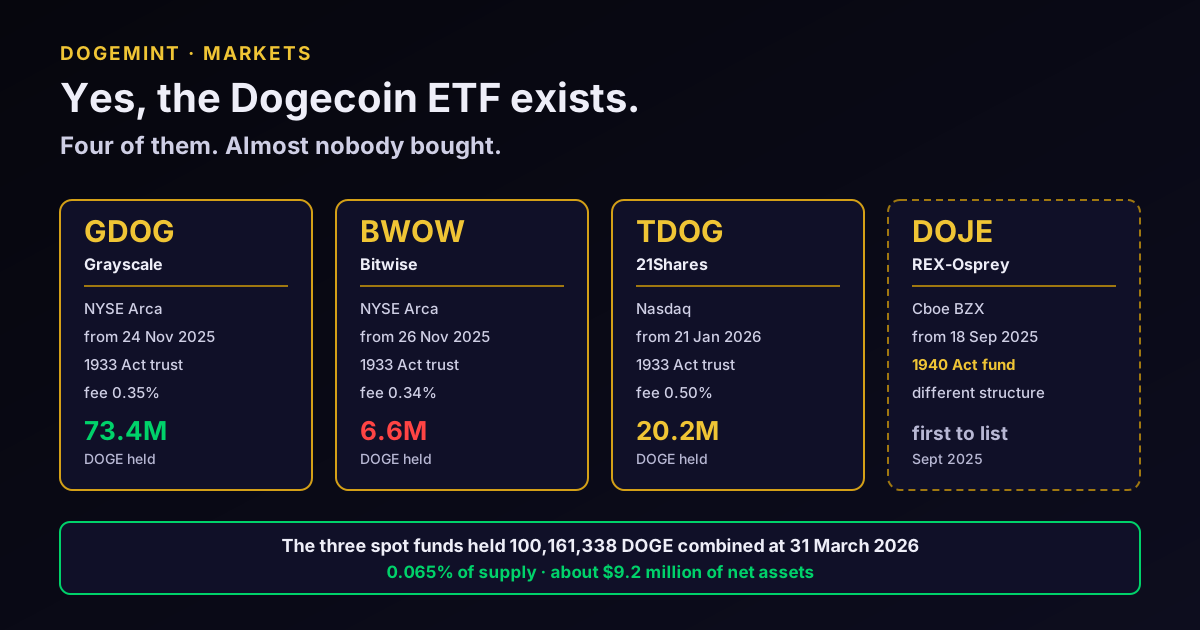
The four products that actually exist
Search results for this question are full of pages written before any of these launched, so they hedge. No hedging needed now. Each of these has a file number, a CIK, and financial statements you can pull yourself.
| Fund | Ticker | Exchange | Trading since | Structure | Sponsor fee |
|---|---|---|---|---|---|
| Grayscale Dogecoin Trust ETF | GDOG | NYSE Arca | 2025-11-24 | 1933 Act commodity trust | 0.35% |
| Bitwise Dogecoin ETF | BWOW | NYSE Arca | 2025-11-26 | 1933 Act commodity trust | 0.34% |
| 21Shares Dogecoin ETF | TDOG | Nasdaq | 2026-01-21 | 1933 Act commodity trust | 0.50% |
| REX-Osprey DOJE | DOJE | Cboe BZX | 2025-09-18 | 1940 Act fund | Not stated here |
Grayscale's is the odd one historically. The trust was formed on 27 January 2021 and commenced operations on 30 January 2025 as a private placement vehicle, then converted to an exchange-listed product in November 2025. Its filings call that the "Uplisting Date." On the same day it cut its sponsor fee from 2.5% to 0.35%, which tells you roughly what a captive private placement can charge and what a competitive exchange listing cannot.
Three different things are all being called an ETF
This is where most coverage goes wrong, and the distinction matters because it changes what you own.
GDOG, BWOW and TDOG are registered under the Securities Act of 1933 as commodity-based trusts. The trust holds Dogecoin. Authorised participants create and redeem shares in blocks, Grayscale's are baskets of 10,000 shares, and the share price tracks the DOGE the trust holds minus expenses. There is no manager picking anything. It is a wrapper.
DOJE is registered under the Investment Company Act of 1940, the law that governs mutual funds. That route sidesteps the 1933 Act commodity-trust process by holding its exposure partly through a subsidiary, which is why it reached the market in September 2025, before the other three, and why it was billed as the first US Dogecoin ETF. Same word, different machine underneath.
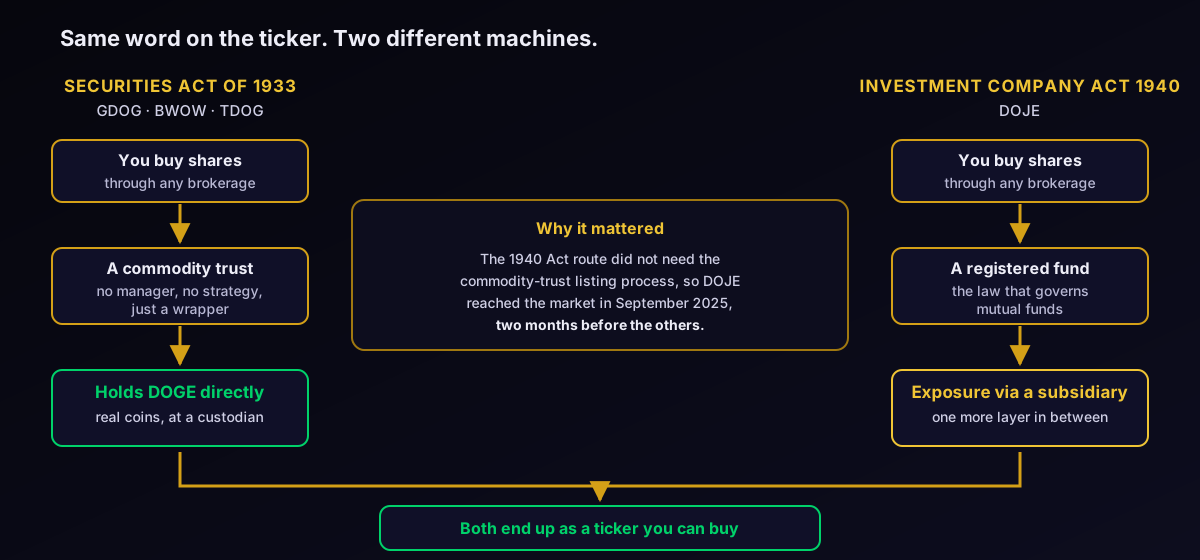
Worth naming what none of these are. None is a futures fund holding CME-style contracts, and none is a staking product, because Dogecoin has no staking to do. We wrote up why DOGE cannot be staked separately, and the short version is that it is a proof-of-work chain that pays miners, not holders. Any "Dogecoin ETF with yield" you see advertised is not one of these four.
The SEC never actually voted on these
The interesting regulatory story is that the individual approvals people spent years waiting for did not happen. The rule changed underneath them.
On 17 September 2025 the Commission granted accelerated approval to proposed rule changes from Nasdaq, Cboe BZX and NYSE Arca adopting generic listing standards for Commodity-Based Trust Shares. It was published in the Federal Register on 22 September 2025 as Release No. 34-103995. The effect is that an exchange no longer needs a separate Rule 19b-4 order from the SEC for each individual product. If a proposed listing meets the generic criteria, it can list.
The gate is a surveillance test, and it is worth reading the actual language rather than a summary of it. A commodity qualifies if, on an initial and continuing basis, it trades on a market that is an Intermarket Surveillance Group member, or if:
the commodity underlies a futures contract that has been made available to trade on a designated contract market ("DCM") for at least six months; provided that the Exchange has a comprehensive surveillance sharing agreement ("CSSA"), whether directly or through common membership in ISG, with such DCM
That is the whole mechanism. Not a judgment about whether Dogecoin is a good idea, and not a view on the joke. A question about whether the exchange can get trading data to detect manipulation. Once regulated DOGE futures had six months of history behind them, the listing became administrative.
So the honest framing of "the SEC approved a Dogecoin ETF" is: the SEC approved a process, and Dogecoin walked through it along with a queue of other assets. Anyone telling you the Commission specifically blessed DOGE is describing something that did not happen.
The number the press releases left out
Here is where it gets unglamorous. Every one of these funds files quarterly financial statements, and those statements are dull in a very specific way.
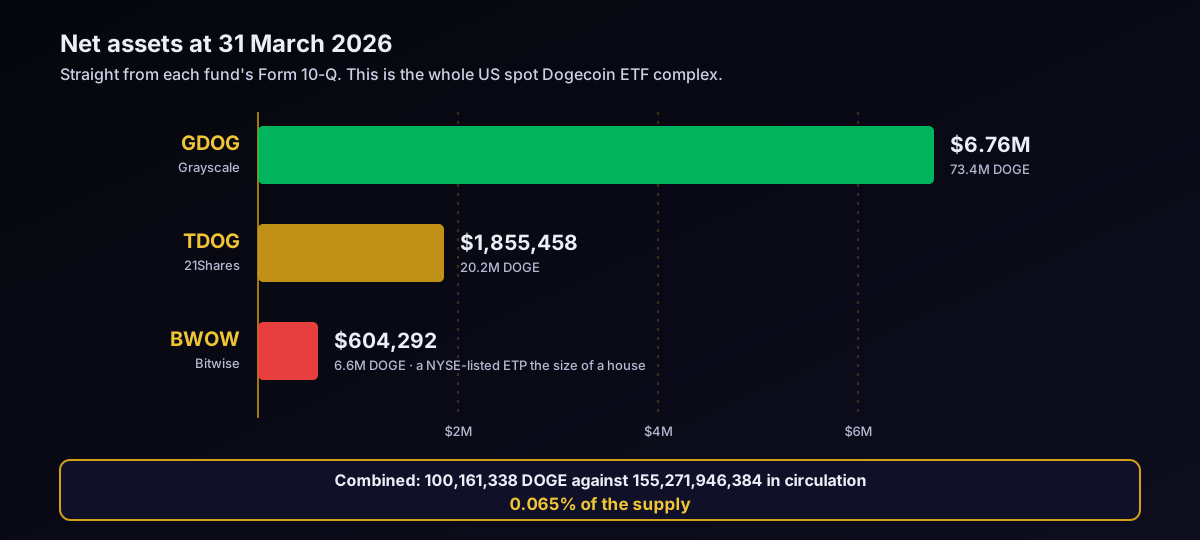
At 31 March 2026, Grayscale's GDOG held 73,430,458 DOGE against net assets of about $6.76 million, spread over 624,700 shares at a NAV of $10.82. 21Shares' TDOG held 20,163,411 DOGE and net assets of $1,855,458. Bitwise's BWOW held 6,567,470 DOGE and net assets of $604,292.
Six hundred thousand dollars. That is not a typo, and it is not a rounding error in a bigger number. BWOW is a fully registered, NYSE Arca-listed exchange-traded product with the assets of a modest house.
Add the three together and you get roughly 100.2 million DOGE and about $9.2 million. Against 155.3 billion coins in circulation, the entire US spot Dogecoin ETF complex owns 0.065% of the supply. For scale on the point rather than a precise comparison, Bitcoin's spot ETFs are routinely described in whole percentage points of BTC supply. DOGE's are in basis points.
The cost bases are worse reading than the balances. Bitwise's fund shows a cost of $1,000,020 against a fair value of $604,470. Grayscale's shows $11,323 thousand of cost against $6,759 thousand of value. 21Shares reports paid-in capital of $2,492,151 and an accumulated loss north of $636,000. Everyone who bought at launch is down, because DOGE is down. The wrapper does not change that, which is the entire point of a wrapper.
Why the "ETF will pump the price" thesis mostly failed here
The argument you heard through 2024 and 2025 went: approval opens the door to institutional money, institutional money buys coins, coins get scarcer, price goes up. It is a reasonable chain of reasoning and it has visibly not worked for DOGE.
Two reasons, and they are not complicated.
First, the funds have to buy the coins they hold, so their buying pressure is exactly proportional to inflows. Roughly $9 million of net assets means roughly $9 million of buying, ever, against a coin with $465 million of trading volume in a single ordinary day. It is inside the noise. It is not a supply shock, it is a rounding difference.
Second, Dogecoin issues 10,000 new coins every minute and always will. The whole ETF complex owns about 100 million DOGE. The network mints 5.256 billion a year. The funds are buying with a teaspoon while the protocol pours. We laid that arithmetic out in Dogecoin versus Bitcoin, and it is the single most underrated fact about the asset.
Bitcoin's ETF story worked partly because Bitcoin's issuance is small, shrinking and capped. Importing that narrative onto a coin with permanent 3.4% annual dilution was always the error. If you want the four variables that actually move DOGE, we went through them in our 2026 read.
ETF or the actual coin?
A real question with a real answer that depends on your account, not on your conviction.
| Spot ETF (GDOG, BWOW, TDOG) | Dogecoin in your own wallet | |
|---|---|---|
| Ongoing cost | 0.34% to 0.50% a year, charged in every market | None. You pay per transaction, not per year |
| Trading hours | Exchange hours only | Always |
| Retirement accounts | Works in an IRA or 401(k) brokerage window | Needs a specialist custodian |
| Custody | Someone else's problem | Yours, entirely |
| Can you spend it | No | Yes |
| Can you send it | No | Yes, in about a minute |
| Counterparty exposure | Sponsor, custodian, authorised participants | Only your own key management |
| Tax paperwork | Standard brokerage reporting | You track your own cost basis |
Rule: if the reason you want DOGE is that you want to hold an asset inside a retirement account without touching a seed phrase, the ETF is genuinely the right tool and 0.35% a year is a fair price for that. If the reason you want DOGE is anything to do with using it, the ETF gives you none of what makes it interesting.
There is a middle answer nobody mentions. You can do both, and most people who tried the ETF route for the account benefits still keep a spending wallet. If that is you, our wallet guide covers what to run, and how to buy DOGE in 2026 covers the exchange side. On the tax side, note the ETF and the coin are not treated identically in practice, mostly because one generates a broker statement and the other makes you build your own; our tax piece has the disposal rules.
What to check before you buy any of them
These are small funds, and small funds behave differently from large ones. Four things worth looking at, all free:
- The bid-ask spread, not the expense ratio. On a fund with $604,000 in it, the spread you pay on the way in and out will dwarf a 0.34% annual fee. Look at the actual quote before deciding which ticker.
- Premium or discount to NAV. Every one of these publishes NAV daily. Thin products can drift from it. Paying 2% over NAV to save 0.15% in fees is a bad trade.
- The latest 10-Q on EDGAR. Search the fund name, read the Schedule of Investments. It is two pages and it tells you the real size.
- Whether a fee waiver is still running. All three used introductory waivers that have now expired. The rate you read in a launch article from last November may not be the rate you pay.
And the obvious one. A wrapper does not change the asset. If DOGE falls 40%, an ETF holding DOGE falls about 40% and then charges you for the year. Whether the asset is worth holding at all is the actual question, and we argued both sides of it in the "is Dogecoin dead" reality check. If you are weighing it against the rest of the category, our 2026 meme coin ranking is the comparison, and the fee piece covers what it costs to actually move the coin version.
Reading material
Sources
- Grayscale Dogecoin Trust ETF (GDOG), Form 10-Q for the quarter ended 31 March 2026 · S-1 effective 2025-11-21, began trading NYSE Arca 2025-11-24, fee cut 2.5% to 0.35%, 73,430,458 DOGE, net assets $6,759 thousand, NAV $10.82 · SEC EDGAR, verified 2026-07-29
- Bitwise Dogecoin ETF (BWOW), Form 10-Q for the quarter ended 31 March 2026 · S-1 effective 2025-11-25, began trading 2025-11-26, sponsor fee 0.34%, 6,567,469.65 DOGE, net assets $604,292 · SEC EDGAR, verified 2026-07-29
- 21Shares Dogecoin ETF (TDOG), Form 10-Q for the period ended 31 March 2026 · Nasdaq listing, commenced investment operations 2026-01-21, unitary sponsor fee 0.50%, 20,163,410.90 DOGE, net assets $1,855,458 · SEC EDGAR, verified 2026-07-29
- SEC Release No. 34-103995: Order Granting Accelerated Approval to Adopt Generic Listing Standards for Commodity-Based Trust Shares · Nasdaq, Cboe BZX and NYSE Arca; the ISG and six-month DCM futures conditions quoted above · Federal Register, published 2025-09-22, verified 2026-07-29
- REX ETF Trust filing history (DOJE), including the 2025-09-18 registration exhibits · corroborates the DOJE launch date · SEC EDGAR, verified 2026-07-29
- REX Shares: launch announcement for the REX-Osprey DOJE fund, 18 September 2025 · issuer statement of the 1940 Act structure · REX Shares, verified 2026-07-29
- DOGE price, circulating supply of 155,271,946,384 and 24-hour volume of $465.4 million · CoinGecko, verified 2026-07-29
- Dogecoin Core, GetDogecoinBlockSubsidy: a constant 10,000 DOGE per block · the issuance figure used above · Dogecoin Project on GitHub, verified 2026-07-29