Dogecoin transaction fees and confirmation times explained
The median Dogecoin fee over the last 24 hours was 0.019 DOGE. At today's price of $0.0702 that is $0.0013, about a tenth of a cent. Blocks land every 63 seconds against a 60 second target, so one confirmation takes about a minute and six take about six. The fee is cheap for a reason nobody puts in the marketing: Dogecoin blocks hold a megabyte and the network is using roughly half of one percent of that. There is no fee auction because there is nothing to bid for.
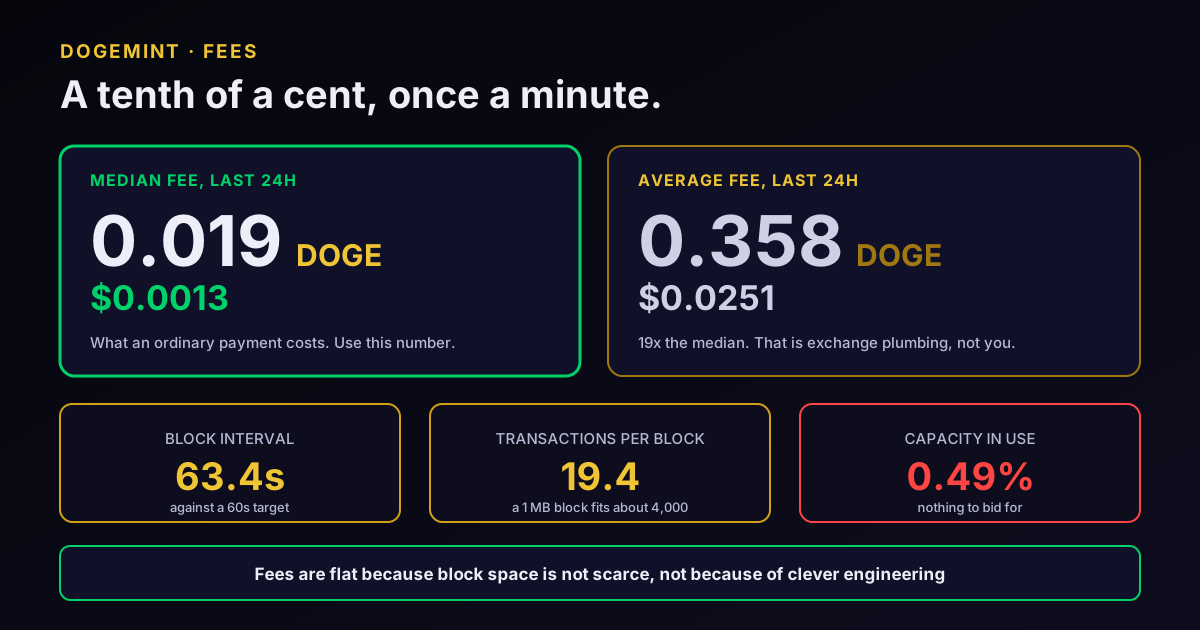
What a Dogecoin transaction actually costs today
Two numbers get quoted for fees and they disagree wildly, so it is worth knowing which one to use.
| Measure | In DOGE | In dollars | What it tells you |
|---|---|---|---|
| Median fee, 24h | 0.019 DOGE | $0.0013 | What a normal payment costs. Use this one. |
| Average fee, 24h | 0.358 DOGE | $0.0251 | Dragged up by a few huge multi-input transactions |
| Recommended minimum | 0.01 DOGE per kB | $0.0007 per kB | What Dogecoin Core tells wallets to pay |
| Relay minimum | 0.001 DOGE per kB | $0.00007 per kB | Below this, nodes will not forward it at all |
| A 192-byte payment | 0.00192 DOGE | $0.00013 | The project's own worked example |
Notice the median is roughly ten times what a simple 200-byte transaction strictly has to pay. That gap is not congestion, it is padding. Most wallets round up, or ship a conservative default and never revisit it, because when the real number is a hundredth of a cent nobody files a bug about it.
The average being 19 times the median is the other thing worth reading. That is what a chain looks like when a handful of exchange consolidation transactions with hundreds of inputs sit alongside tens of thousands of small payments. If you see a headline quoting Dogecoin's average fee, it is describing exchange plumbing, not your payment.
Every fee in the node comes from one constant
Dogecoin's fee policy is unusually easy to audit, because there is essentially one number and everything else is arithmetic on it. In src/policy/policy.h, under a comment that says exactly what it does:
/** Recommended transaction fee by Dogecoin Core developers
  *
  * All fee defaults used throughout the client derive their
  * value from this base default.
  */
static const CAmount RECOMMENDED_MIN_TX_FEE = COIN / 100;
COIN is 100,000,000, set in src/amount.h, so COIN / 100 is 0.01 DOGE. Every other threshold in the client is that value multiplied or divided by a power of ten.
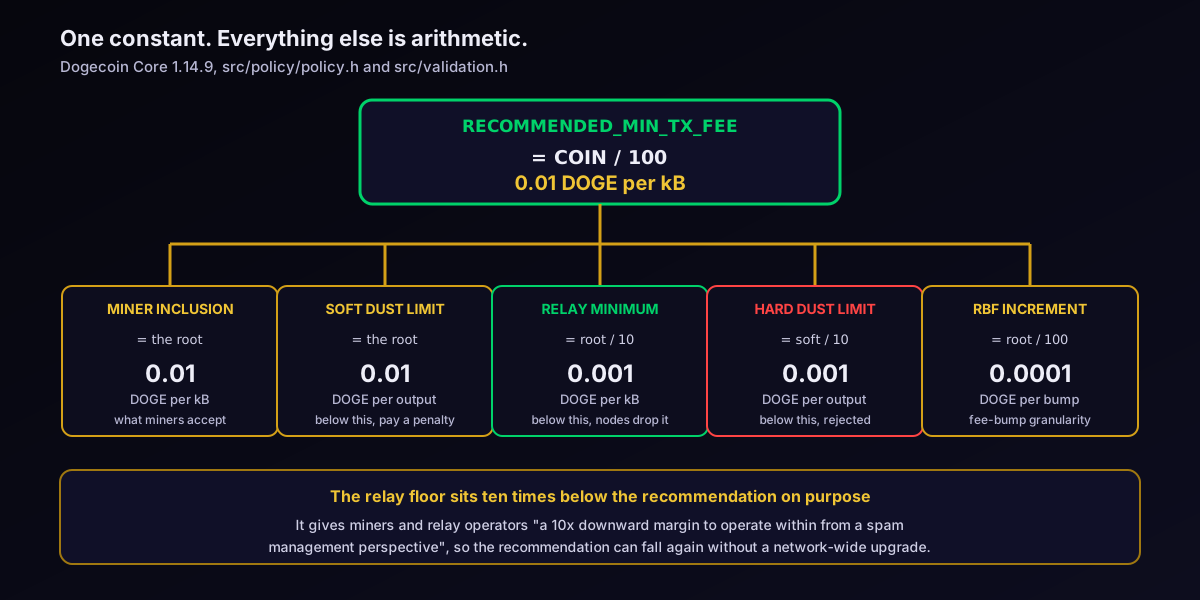
The relay minimum sits at one tenth of the recommendation deliberately. The project's fee documentation explains the reasoning, and it is good engineering: "This gives miners and relay operators a 10x downward margin to operate within from a spam management perspective." In other words, the recommendation can be lowered later without needing every node on the network to upgrade first. The margin is already there.
Why fees collapsed in 2021, and what actually changed
People remember that Dogecoin fees got cheap and usually credit 1.14.5. That is half right. It was two releases, and the second change is the one that did the heavy lifting for small payments.
Before August 2021, DEFAULT_MIN_RELAY_TX_FEE was set to COIN. Not a fraction of a coin. One whole DOGE per kilobyte, just to get your transaction relayed.
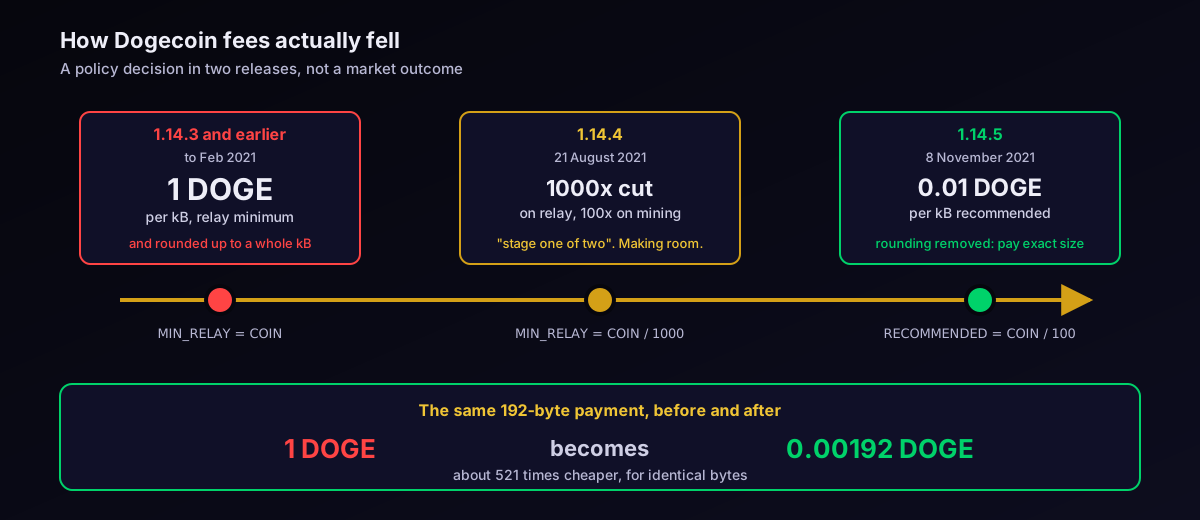
Stage one, version 1.14.4, released 21 August 2021. The release notes call the section "Enabling Future Fee Reductions" and describe it as "reducing the default fee requirement 1000x for transaction relay and 100x for mining." In the code, DEFAULT_MIN_RELAY_TX_FEE went from COIN to COIN / 1000. Nothing changed for users yet. This was making room.
Stage two, version 1.14.5, released 8 November 2021. The recommendation itself dropped to 0.01 DOGE per kilobyte. And quietly, in the same release, the rounding function came out. From the project's fee documentation:
In the past, Dogecoin has enforced a rounding function in the fee mechanism. Since version 1.14.5, this is no longer the case, and fees are calculated over the exact size of a transaction. For example, a 192 byte transaction only has to pay 0.01 / 1000 * 192 = 0.00192 DOGE fee.
That is the change worth understanding. Under the old scheme, a 192-byte payment was rounded up to a full kilobyte and charged as though it were five times larger. So a small transaction was paying the per-kilobyte rate for space it never used. Removing the rounding cut the bill for ordinary payments by roughly another five times on top of the rate cut.
Put both stages together on that same 192-byte transaction and you go from 1 DOGE to 0.00192 DOGE. About 521 times cheaper, for identical bytes. That is the real answer to why Dogecoin fees fell, and it was a policy decision, not a market outcome.
Confirmation times, and the trap in counting them
Dogecoin's block target is set in src/chainparams.cpp as nPowTargetSpacing = 60, followed by the comment // 1 minute. Real performance is close. Over the 24 hours to 29 July 2026 the chain produced 1,363 blocks, which is one every 63.4 seconds.
Since Digishield activated at block 145,000, difficulty retargets every single block instead of every 2,016. So when hashrate moves, Dogecoin corrects within minutes rather than drifting for a fortnight. It is the reason the real block time tracks the target as tightly as it does.
| Confirmations | Roughly how long | Typically enough for |
|---|---|---|
| 0 (in the mempool) | Seconds | Nothing you cannot afford to lose. Not settled. |
| 1 | About 1 minute | A coffee, a tip, a small online purchase |
| 6 | About 6 minutes | The old rule of thumb, fine for most retail amounts |
| 20 to 40 | 21 to 42 minutes | What many exchanges require before crediting a deposit |
| 100+ | Over 1.5 hours | Large transfers, if you want to be careful |
Here is the part worth internalising. A confirmation is not a unit of time, it is a claim about how much work an attacker would have to redo. A Dogecoin block carries far less accumulated work than a Bitcoin block, so six DOGE confirmations and six BTC confirmations are not the same assurance. DOGE is genuinely faster. It is not faster at the same level of security, and we took that comparison apart properly in Dogecoin versus Bitcoin.
There is no fee market, and the arithmetic says why
This is the section that explains everything above, and it is a capacity problem rather than a design triumph.
Dogecoin blocks hold one megabyte. A plain payment is roughly 250 bytes, so a full block would carry about 4,000 transactions. Over the 24 hours to 29 July 2026 the network processed 26,461 transactions across 1,363 blocks, which is 19.4 transactions per block.
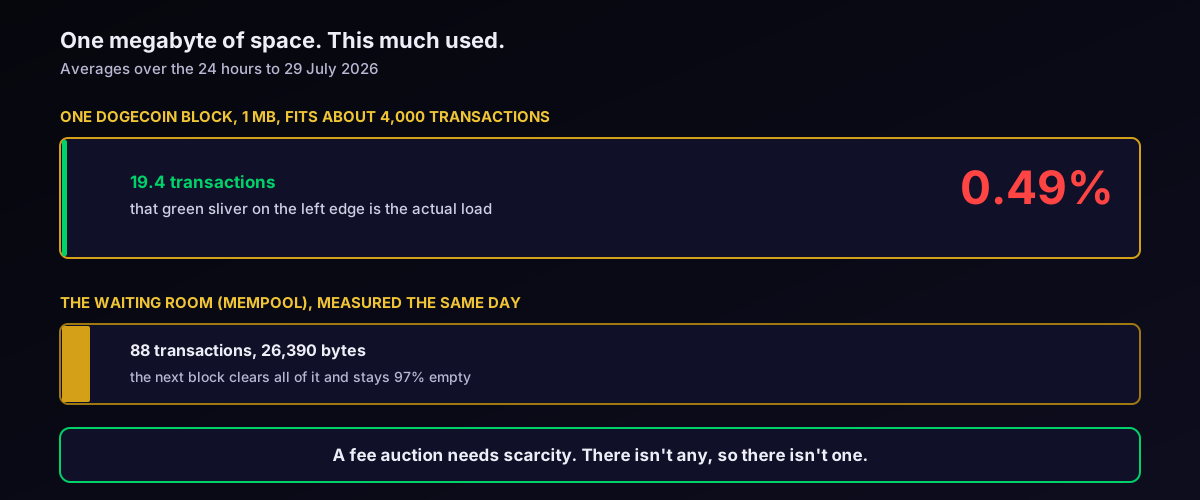
That is 0.49% of capacity. The waiting room held 88 transactions, about 26 kilobytes, which the next block clears with 97% of itself still empty.
A fee auction forms when demand for block space exceeds supply and users outbid each other to get in. On Dogecoin that has essentially never had to happen in normal conditions. Miners take whatever is offered because the alternative is mining an emptier block. This is why the fee is stable and predictable in a way Bitcoin's is not, and it is worth being honest about the source: Dogecoin has cheap fees partly because it is not very busy.
The uncomfortable corollary is that this is only true while it stays quiet. In the 2021 mania, the chain did see backlogs and wallets that had not updated their defaults were the ones that got stuck. Cheap fees are a property of current demand, not a guarantee written into the protocol.
Dust limits, which is what actually bites people
Most people who hit a fee problem on Dogecoin have not hit a fee problem. They have hit a dust limit, and the error message rarely says so.
Dogecoin Core runs two, both derived from the same root constant:
- Hard dust limit, 0.001 DOGE. An output below this is non-standard. Nodes reject the transaction and it never reaches a miner.
DEFAULT_HARD_DUST_LIMIT = DEFAULT_DUST_LIMIT / 10. - Soft dust limit, 0.01 DOGE. An output below this is allowed, but you must add 0.01 DOGE to the fee for each such output. The docs put it plainly: it makes the output "economically unviable."
There is a wallet-side consequence people trip over constantly. The Dogecoin Core wallet discards change to the fee if the change would fall under the dust limit. So if you send an amount that leaves 0.008 DOGE of change, that change is not returned to you, it goes to the miner. It is a fraction of a cent and it is working as designed, but it surprises people who watch their balance closely.
The related annoyance is consolidation. If you have received hundreds of tiny tips, each one is a separate unspent output, and spending them all in one transaction makes a very large transaction. Size is what you pay for. A wallet holding 400 small inputs can produce a transaction of tens of kilobytes, and the fee scales with every one of them. That is exactly the mechanism behind the 0.358 DOGE average.
How not to overpay
At these prices overpaying by 10x costs you a cent, so this is a matter of tidiness rather than economics. Still, four things are worth doing:
- Update your wallet. If you are running anything from before Dogecoin Core 1.14.5, you are on the old rounding behaviour and paying multiples of what you need to. The current release is 1.14.9, published 1 December 2024. Our wallet guide covers what is worth running.
- Do not consolidate during a busy spell. If you are merging many small inputs, do it when the mempool is empty, which on Dogecoin is most of the time.
- Watch the exchange, not the chain. The fee to move DOGE is a tenth of a cent. The withdrawal fee an exchange charges you is set by the exchange and is routinely 2 to 5 DOGE, hundreds of times the network cost. That is where your money actually goes, and it is covered in how to buy DOGE in 2026.
- Check the deposit requirement before you send. Confirmation counts vary a lot between venues and a 40-confirmation policy means a 42-minute wait, which is not a stuck transaction.
The one-line summary: on Dogecoin, the network fee is almost never the expensive part of what you are doing. The exchange is. If you are spending DOGE rather than trading it, the spending guide is the practical follow-up, and if you are wondering whether the mining side is worth it at these fee levels, the mining guide answers that with the same bluntness. For the wrapper version that skips the chain entirely, see the Dogecoin ETF piece, and for how any of this gets taxed, the tax rules.
Reading material
Sources
- Dogecoin Core 1.14.9, src/policy/policy.h · RECOMMENDED_MIN_TX_FEE = COIN / 100, DEFAULT_DUST_LIMIT, DEFAULT_HARD_DUST_LIMIT and the "all fee defaults derive from this base default" comment · Dogecoin Project on GitHub, verified 2026-07-29
- Dogecoin Core 1.14.9, src/validation.h · DEFAULT_MIN_RELAY_TX_FEE = RECOMMENDED_MIN_TX_FEE / 10, HIGH_TX_FEE_PER_KB · Dogecoin Project on GitHub, verified 2026-07-29
- Dogecoin Fee Recommendation (doc/fee-recommendation.md) · the 0.01 DOGE/kB recommendation, both dust limits, the 10x relay margin quote, and the 192-byte worked example after the 1.14.5 rounding removal · Dogecoin Project on GitHub, verified 2026-07-29
- Dogecoin Core 1.14.4 release notes, published 2021-08-21 · "Enabling Future Fee Reductions", relay cut 1000x and mining 100x, described as stage one of two · Dogecoin Project on GitHub, verified 2026-07-29
- Dogecoin Core 1.14.5 release notes, published 2021-11-08 · "Fee Reductions" finalising the 0.01 DOGE/kB recommendation · Dogecoin Project on GitHub, verified 2026-07-29
- Dogecoin Core 1.14.3, src/validation.h · the pre-reduction DEFAULT_MIN_RELAY_TX_FEE = COIN, i.e. 1 DOGE per kilobyte · Dogecoin Project on GitHub, verified 2026-07-29
- Dogecoin Core 1.14.9, src/chainparams.cpp · nPowTargetSpacing = 60 with the "1 minute" comment · Dogecoin Project on GitHub, verified 2026-07-29
- Blockchair Dogecoin network statistics · block height 6,310,018, 1,363 blocks and 26,461 transactions in 24h, median fee 1,900,000 koinu, average fee 35,803,575 koinu, mempool of 88 transactions and 26,390 bytes · Blockchair, verified 2026-07-29
- Dogecoin Core release history · confirms 1.14.9 (2024-12-01) is the current release · Dogecoin Project on GitHub, verified 2026-07-29
- DOGE price of $0.0702, used for every dollar conversion above · CoinGecko, verified 2026-07-29