Dogecoin vs Bitcoin: what's actually different
The difference is supply, and everything else is downstream of it. Bitcoin stops at 21 million coins and halves its issuance every four years or so. Dogecoin pays a flat 10,000 coins per block, once a minute, forever, with no cap and no halving ever again. That's 5.256 billion new DOGE a year, permanently. Block times, fees, mining, and the reason people hold each one all follow from that single line of code. As of 29 July 2026 Bitcoin trades at $64,111 with a $1.29 trillion market cap, and DOGE at $0.0702 with $10.9 billion.
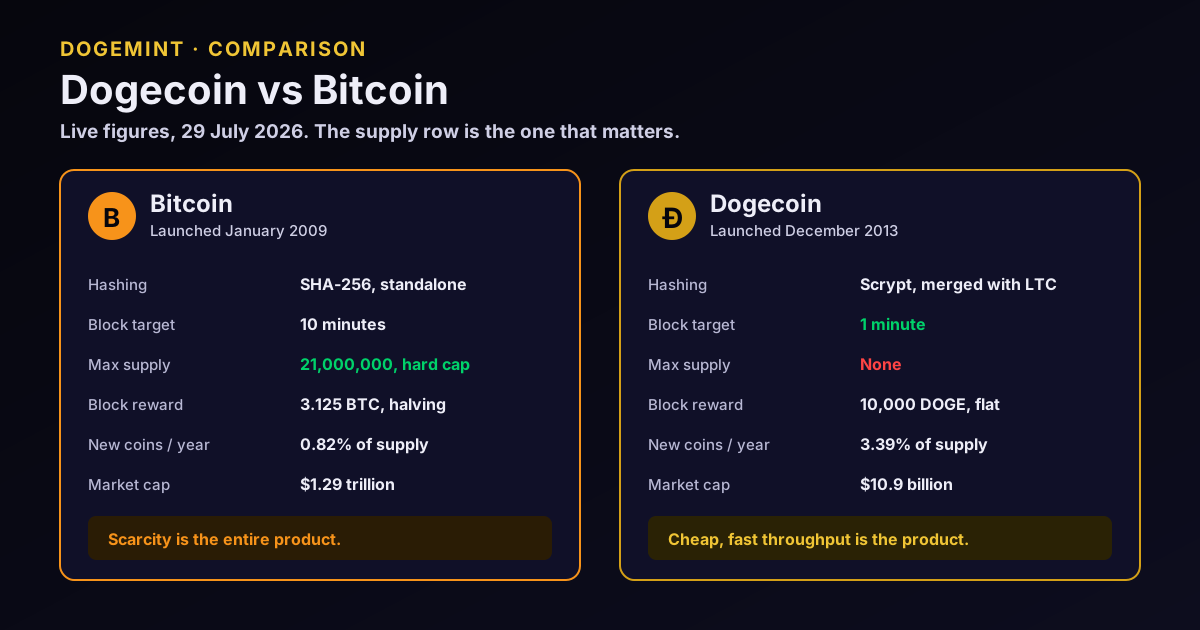
The whole comparison on one screen
Both chains descend from the same 2009 codebase, which is why so many of these rows rhyme. Dogecoin borrowed Bitcoin's architecture and then changed four things: the hash function, the block interval, the difficulty algorithm, and the money. The first three are engineering choices you could argue either way. The fourth is a different philosophy wearing the same clothes.
| Bitcoin | Dogecoin | |
|---|---|---|
| Launched | January 2009, Satoshi Nakamoto | December 2013, Billy Markus and Jackson Palmer |
| Hash algorithm | SHA-256 | Scrypt |
| Block target | 600 seconds | 60 seconds |
| Halving interval | Every 210,000 blocks | None since block 600,000 |
| Current block reward | 3.125 BTC | 10,000 DOGE, permanently |
| Maximum supply | 21,000,000 | No cap |
| Circulating supply | 20,062,821 | 155,271,036,383 |
| New coins per year | ~164,250 BTC (0.82%) | 5,256,000,000 DOGE (3.39%) |
| Subsidy value per year | ~$10.5 billion | ~$369 million |
| Secured by | Its own miners | Litecoin's miners, via merged mining |
| Market cap | $1.286 trillion (rank 1) | $10.90 billion (rank 11) |
| All-time high | $126,080 on 2025-10-06 | $0.7316 on 2021-05-07 |
| Down from that high | 49% | 90% |
Note the row nobody puts in these comparisons: subsidy value per year. Bitcoin pays roughly $10.5 billion a year to the people defending it. Dogecoin pays about $369 million, and as the next section explains, DOGE isn't really the one buying its own defence anyway.
Supply is the actual difference
Bitcoin's rule is four lines long. GetBlockSubsidy starts at 50 BTC and right-shifts by the number of halvings, with 210,000 blocks per halving. Blocks 0 to 209,999 paid 50, then 25, then 12.5, then 6.25, and since April 2024 it's been 3.125. The chain sat at block 960,118 on 29 July 2026, so the next halving arrives at block 1,050,000, roughly 90,000 blocks out, which at ten minutes a block lands sometime in 2028.
Dogecoin's rule started the same way and then deliberately stopped. Its halving interval is 100,000 blocks, and GetDogecoinBlockSubsidy halves only while the height is below six of those intervals. Past block 600,000, the function does this and nothing else:
} else {
    // Constant inflation
    return 10000 * COIN;
}
The chain crossed block 600,000 in 2015. It's at 6,309,962 now. So for more than five and a half million blocks, Dogecoin has issued exactly the same amount every minute, and it always will.
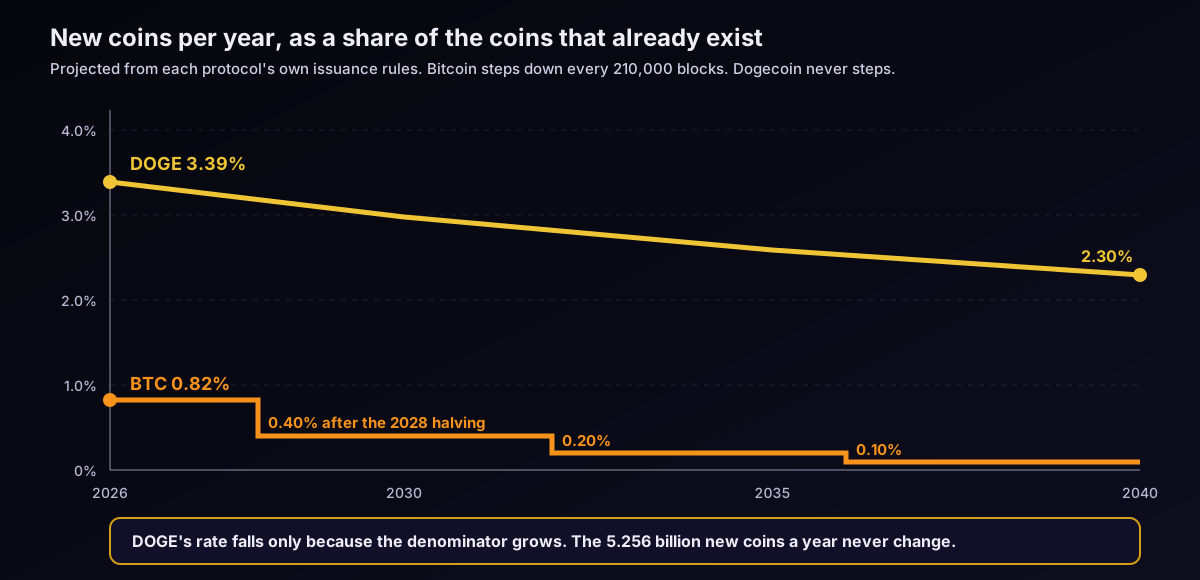
The honest version of the pro-DOGE argument here: constant absolute issuance means the percentage falls over time, so DOGE is disinflationary even if it's never deflationary. That's true. It's also slow. At 3.39% today, DOGE takes until roughly 2040 to reach 2.3%, while Bitcoin will be under 0.1% by then. Anyone holding DOGE is accepting about 3.4% annual dilution as the cost of entry, which is roughly the pace of a mediocre inflation year, applied to your holdings every year with no end date.
The counterargument nobody makes carefully: 3.4% dilution is trivially small compared to DOGE's actual volatility. The coin has moved more than that in an afternoon. If you're holding DOGE, issuance is nowhere near the biggest risk on your position, which is a genuine reason not to obsess over it. It's a bad reason to pretend the schedules are equivalent. We took apart the related confusion, that predictable issuance somehow means price stability, in this piece on why DOGE isn't a stablecoin.
Dogecoin's first 145,000 blocks paid out at random
Here's a piece of the divergence that almost never gets mentioned, and it's still sitting in the code.
Bitcoin's subsidy has been deterministic since block zero. Dogecoin's wasn't. For its first 145,000 blocks, GetDogecoinBlockSubsidy took a slice of the previous block's hash, used it to seed a Mersenne Twister, and paid the miner a random amount up to a ceiling that started at 999,999 DOGE and halved on schedule. Block rewards were a lottery. Miners genuinely did not know what a block was worth until they found it, which is about as on-brand as a 2013 joke currency could get.
That ended at block 145,000, where fSimplifiedRewards turns on in the consensus parameters and rewards become the flat, predictable numbers everyone assumes were always there. The same upgrade brought in Digishield, which retargets difficulty every single block instead of every 2,016 like Bitcoin. Dogecoin needed it: multipool miners were hopping onto the chain, mining a burst of cheap blocks, and leaving the difficulty stranded high for everyone else.
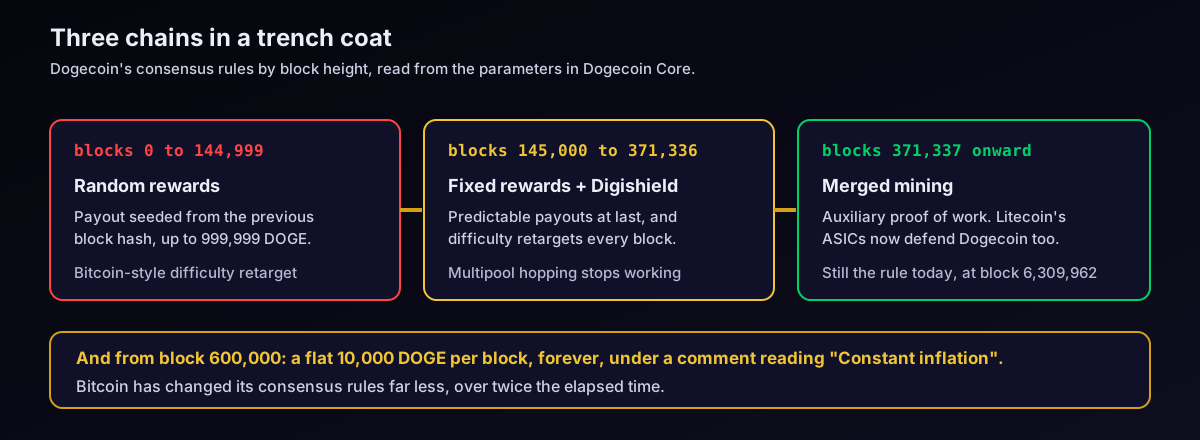
So the timeline is three chains in a trench coat. Blocks 0 to 144,999: random rewards, Bitcoin-style difficulty. Blocks 145,000 to 371,336: fixed rewards, per-block difficulty retargeting. Block 371,337 onward: all of that plus merged mining. Bitcoin has changed its consensus rules far less in twice the time.
One more artifact worth pointing at. Dogecoin's auxiliary-proof-of-work chain identifier is set in the source as nAuxpowChainId = 0x0062, hex for 98, and the comment on that line reads // 98 - Josh Wise!. The community crowdfunded a NASCAR sponsorship for driver Josh Wise's number 98 car in 2014, and somebody encoded the car number into the consensus rules. It's still there, in every node on the network, twelve years later.
Speed and fees: DOGE wins, and it matters less than the marketing says
A one-minute block against a ten-minute block is a real, felt difference. Six DOGE confirmations take about six minutes. Six Bitcoin confirmations take about an hour. In practice Bitcoin's average was running at 10.2 minutes per block in late July 2026, slightly above target because hashrate had been climbing into the difficulty adjustment.
Fees are lopsided in the same direction. Median DOGE transaction fees were around 0.019 DOGE in late July 2026, which is roughly a tenth of a cent. Bitcoin's fee market prices in an actual block-space auction and swings from a few cents to many dollars depending on demand.
| Moving money | Bitcoin | Dogecoin |
|---|---|---|
| Target block interval | 600 seconds | 60 seconds |
| Actual average, late July 2026 | 10.2 minutes | About 1 minute |
| Time to six confirmations | About 60 minutes | About 6 minutes |
| Median transaction fee | Set by a block-space auction, cents to dollars | About 0.019 DOGE, roughly a tenth of a cent |
| Transactions in 24 hours | 621,676 | 26,482 |
| Difficulty retarget | Every 2,016 blocks | Every block, since Digishield |
Here's the part the DOGE marketing skips. Confirmations are not interchangeable units. A confirmation is a claim about how much work would have to be redone to reverse your transaction, and one Bitcoin block represents vastly more work than one Dogecoin block. Ten fast confirmations on a lightly defended chain are not equal to one confirmation on a heavily defended one. For a $12 purchase, nobody cares and DOGE is genuinely the better tool. For settling a large amount, the assurance gap is the whole point. Which is a fine trade, as long as you know you're making it. Our spending guide covers where the fast, cheap version is actually useful.
Dogecoin doesn't secure itself
This is the most interesting structural fact about DOGE and it rarely makes these comparisons at all.
At block 371,337 in 2014, Dogecoin activated auxiliary proof of work. In Dogecoin Core's chainparams you can see it as auxpowConsensus.nHeightEffective = 371337. From that block on, a Scrypt miner could submit the same proof of work to both Litecoin and Dogecoin. One computation, two chains, two payouts.
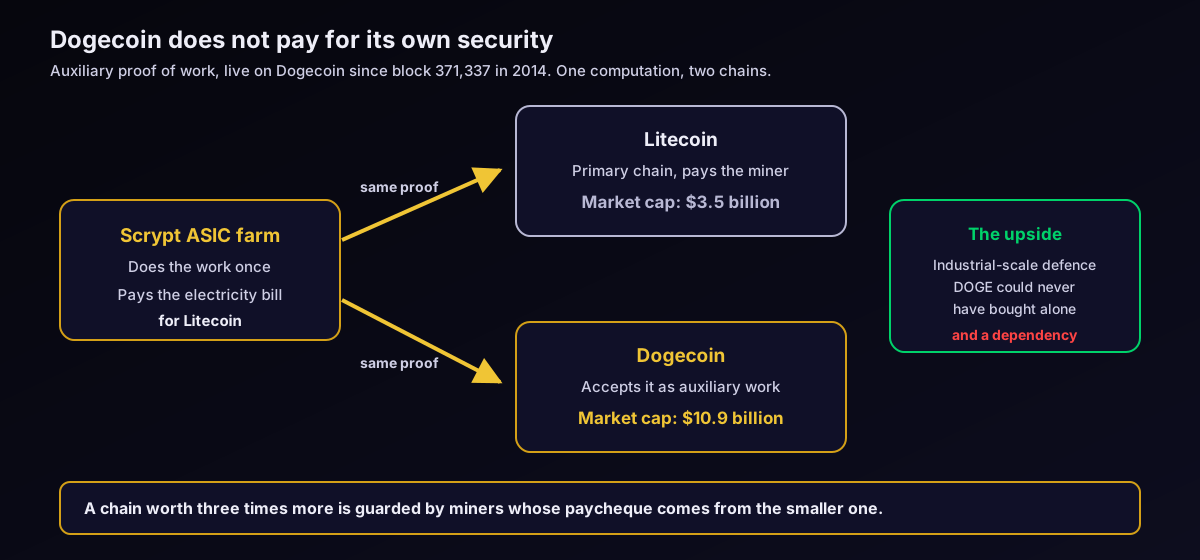
The arithmetic is genuinely strange. Dogecoin's market cap is $10.9 billion. Litecoin's is $3.5 billion. So the more valuable chain is being defended by hashpower whose economics are anchored to the less valuable one. Before merged mining, Dogecoin was a small Scrypt chain with a hashrate an attacker could plausibly rent. Afterwards, attacking DOGE meant out-hashing Litecoin's industrial ASIC fleet, which is a completely different proposition.
That was one of the smartest decisions in the coin's history, and it created a dependency. DOGE's security budget is not really DOGE's. If Scrypt ASIC mining ever stopped being profitable on Litecoin, Dogecoin would find out what its own $369 million a year buys. Bitcoin has no equivalent dependency: it pays its own miners, in its own coin, and always has. We went through the mining side in detail in the 2026 mining guide, and the short version is that this structure is exactly why you cannot compete with a laptop.
You cannot compare the hashrates, and everyone does
In late July 2026 Bitcoin's network was running at roughly 853 exahashes per second. Dogecoin's was around 4.9 petahashes per second, though DOGE estimates vary by up to a factor of two between providers. Those numbers look like a rout, and they are meaningless side by side.
Bitcoin hashes with SHA-256. Dogecoin hashes with Scrypt, which was chosen specifically because it's memory-hard and therefore more expensive per hash. A Scrypt hash and a SHA-256 hash are different units of work, so dividing one by the other produces a number with no interpretation at all. It's like comparing a car's top speed to a ship's tonnage.
If you want a comparison that means something, use money: what does each chain pay per year to the people defending it, and what would it cost to rent enough of the relevant hardware to attack it. On the first measure Bitcoin is ahead by roughly 28 to 1. On the second, DOGE punches far above its own subsidy because of the Litecoin arrangement. Neither of those is a hashrate ratio.
What each one is actually for
| Use case | Better tool | Why |
|---|---|---|
| Storing value over a decade | Bitcoin | A fixed cap is the entire thesis. DOGE dilutes about 3.4% a year against you, forever. |
| Sending $20 to a friend today | Dogecoin | One-minute blocks, fees around a tenth of a cent, no fee auction to lose. |
| Tipping, micropayments, small merchant sales | Dogecoin | Bitcoin base-layer fees can exceed the payment. Lightning solves this, at the cost of setup. |
| Settling a large amount | Bitcoin | Confirmation assurance, and it is not close. |
| Institutional exposure through a regulated wrapper | Bitcoin | Spot ETFs exist. DOGE's institutional access is thinner and newer. |
| Participating in a large internet culture | Dogecoin | Said without sarcasm. It's a real driver of DOGE demand and always has been. |
How they behave when things go wrong
Drawdowns tell you more about an asset than its whitepaper does. Bitcoin sits 49% below its October 2025 high of $126,080. Dogecoin sits 90% below its May 2021 high of $0.7316, more than five years later.
Both are volatile. They are not equally volatile, and they don't recover the same way. Bitcoin's cycles have historically been driven by its own supply schedule, ETF flows, and macro liquidity. Dogecoin's are driven by attention, and attention is a much less reliable input than a halving you can put in a calendar. When the culture moves on, DOGE has no scheduled event pulling it back.
That's a real structural weakness and it deserves saying plainly. It's also not the same as the chain being broken, a distinction we spent a whole article on in the "is Dogecoin dead" reality check. And for the four variables that actually move DOGE from here, see our 2026 read.
So which one
Here's a position rather than a shrug. If your reason for buying DOGE is any version of "it's the cheaper Bitcoin," you should buy Bitcoin instead, because that reasoning is about scarcity and DOGE's supply schedule is the opposite of scarce. Price per coin is not cheapness. There will never be a DOGE supply shock, by design.
If your reason for buying DOGE is that you want a fast, nearly free payment rail with deep exchange support and an unusually durable community, that's a coherent reason and DOGE is good at it. Just don't hold it expecting the monetary properties of an asset built on the opposite rule.
Owning both is fine and extremely common. Owning DOGE while explaining it in Bitcoin's language is the mistake. If you're comparing DOGE against its closer peer instead, we did that in Dogecoin versus Shiba Inu, and the buying mechanics for either are in how to buy DOGE in 2026.
Reading material
Sources
- Bitcoin Core, GetBlockSubsidy (50 BTC halved every 210,000 blocks) · Bitcoin Core on GitHub, verified 2026-07-29
- Bitcoin Core chainparams (nSubsidyHalvingInterval 210000, nPowTargetSpacing 600) · Bitcoin Core on GitHub, verified 2026-07-29
- Dogecoin Core, GetDogecoinBlockSubsidy (constant 10000 * COIN past block 600,000) · Dogecoin Project on GitHub, verified 2026-07-29
- Dogecoin Core chainparams (nPowTargetSpacing 60, auxpow effective at height 371337) · Dogecoin Project on GitHub, verified 2026-07-29
- BTC price, market cap, circulating supply, all-time high · CoinGecko, verified 2026-07-29
- DOGE price, market cap, circulating supply, all-time high · CoinGecko, verified 2026-07-29
- LTC market cap, for the merged-mining comparison · CoinGecko, verified 2026-07-29
- Bitcoin network stats (block height 960,118, hashrate, 10.2 minute average block interval) · Blockchain.com, verified 2026-07-29
- Dogecoin network stats (block height 6,309,962, hashrate, median fee, daily transactions) · Blockchair, verified 2026-07-29
- Bitcoin.org on mining and confirmation timing · Bitcoin Project, verified 2026-07-29