Is Dogecoin a stablecoin? No. Here's why people ask.
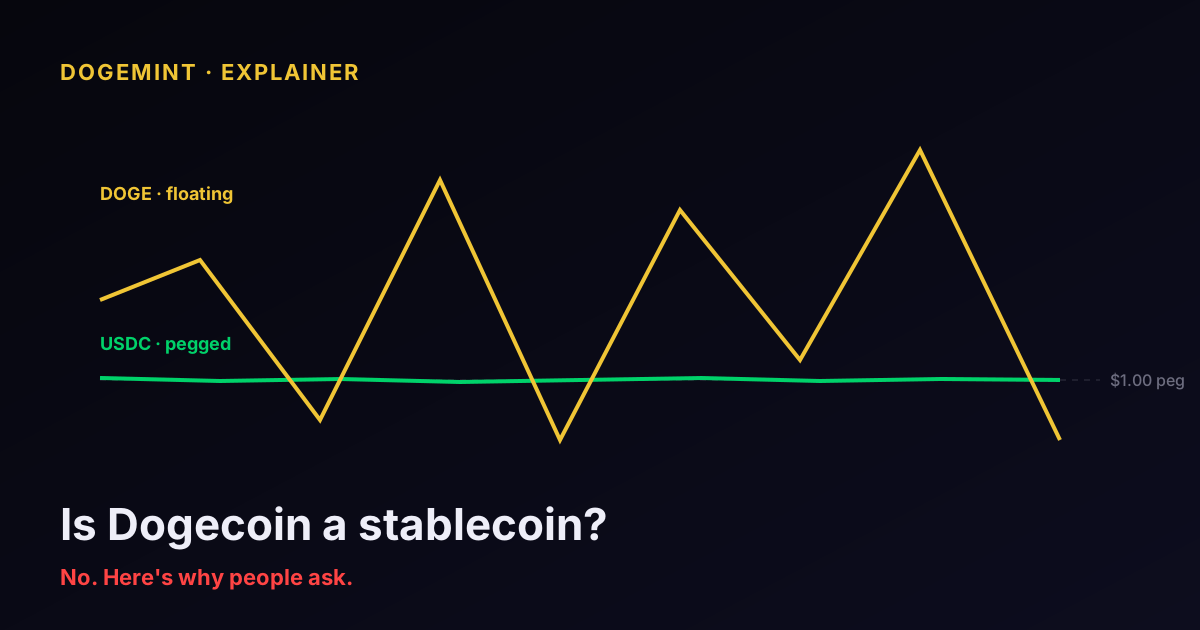
Dogecoin is not a stablecoin. It has no peg to a fiat currency, no reserve assets, and roughly 5.256 billion new DOGE enter circulation every year by protocol design. Its price floats. The reason "is Dogecoin a stablecoin" gets typed into Google a few thousand times a month is mostly a vocabulary mix-up: people mean "established," and they say "stable."
What a stablecoin actually is
A stablecoin is a cryptocurrency engineered to hold a stable value, almost always pegged to $1 USD. The mechanism for holding the peg is the whole point of the coin's existence. Three families:
| Coin | Peg target | Backing | Mechanism |
|---|---|---|---|
| USDC | $1.00 | Cash + short-duration US Treasuries | 1:1 reserves, monthly attestation by an audit firm |
| USDT (Tether) | $1.00 | Mixed reserves: cash, treasuries, commercial paper, gold | 1:1 claimed reserves, quarterly transparency reports |
| DAI | $1.00 | Crypto collateral (ETH, USDC, others) at >100% | Smart contracts that liquidate undercollateralized positions |
| DOGE | None | None | None ·the price is whatever buyers and sellers agree to |
The defining trait of a stablecoin is the peg machinery. Without that, you have a regular cryptocurrency, no matter how popular it is.
What Dogecoin actually is
Dogecoin is a Scrypt proof-of-work cryptocurrency launched on December 6, 2013 by Billy Markus and Jackson Palmer. It runs its own blockchain (not a token on Ethereum). It uses merged mining with Litecoin. The supply is "fixed-issuance," not "fixed-cap": after the initial 100 billion DOGE were mined by 2015, the protocol has issued exactly 10,000 DOGE per block, with one-minute block times, ever since. That works out to roughly 5.256 billion new DOGE per year added to circulation, with no scheduled halving and no maximum supply.
Per day that is 14.4 million DOGE, which is the framing you will see more often, because a daily number feels more visceral than an annual one. Same protocol, same 10,000 DOGE per block, just a different denominator.
Either way, the supply expands. That's the opposite of a stablecoin's peg-defending mechanism. A stablecoin issuer mints new tokens only against new collateral; the Dogecoin protocol mints new tokens to pay miners, regardless of demand.
Why people search this anyway
Three patterns we see in the data.
Vocabulary mix-up
"Stablecoin" sounds like "established coin." A user new to crypto, hearing about Dogecoin, USDC, and Tether in the same conversation, sometimes lumps them as "the safer ones." DOGE is in the top 10 by market cap most years since 2021, which makes it "established" in market terms, but established is not the same as price-stable.
Fixed-issuance confusion
The fact that DOGE issues a fixed 10,000 per block sometimes gets misreported as "Dogecoin's supply is stable" or "DOGE has steady inflation." Steady inflation is a real property; price stability is a different property entirely. A currency with predictable issuance can still have a wildly volatile market price, because the price is set by demand, not by issuance schedule.
Confusion with wrapped DOGE
There are wrapped versions of DOGE on Ethereum (wDOGE) and BNB Chain (DOGE-BEP20). None of them are stablecoins either. They're 1:1 representations of native DOGE, so they inherit DOGE's price behavior. Some users see "wrapped" and assume "wrapped to a dollar," which isn't what the term means in crypto.
What DOGE actually does well
If you came here looking for stablecoin properties from DOGE, you'll be disappointed. If you came here wondering what DOGE is for instead, the honest answers:
- Low-fee payments. Median DOGE transaction fees are usually under $0.01. For peer-to-peer transfers, tipping, and small purchases at a merchant who accepts DOGE directly, that beats most card processors.
- Fast confirmations. One-minute block times mean your transaction is reasonably finalized in 5-10 minutes. Bitcoin takes ~60 minutes for the same confidence level.
- Network effect. DOGE is the recognizable meme coin. Merchant integrations, custodial support at major exchanges, and wallet support are broader than for most non-Bitcoin alternatives.
- Cultural staying power. The DOGE community is one of the longest-running active communities in crypto. Reddit's /r/dogecoin has been active since 2013.
What DOGE does not do is hold a stable price. If your use case is "I need to send my friend a steady $50 worth of crypto and have it still be worth $50 next week," you want USDC or USDT, not DOGE.
Why people sometimes pick DOGE for spending anyway
This part trips up the analysis. If DOGE is volatile, why do merchants accept it? Two reasons:
First, most merchants who accept DOGE convert to fiat at point of sale through a payment processor (BitPay, NOWPayments, CoinGate). The merchant never holds the DOGE; they receive USD. The volatility risk lives with the buyer, not the seller. We cover the full mechanics in our 2026 spending guide.
Second, holders who want to spend DOGE specifically are often people who got DOGE early enough that the volatility worked for them. Spending appreciated DOGE feels different from spending USDC.
If you actually want a stablecoin
Pick USDC for US users who want regulatory clarity (Circle, the issuer, is a US-regulated entity). Pick DAI for users who want a decentralized, on-chain mechanism. Pick USDT for the deepest liquidity globally, with the caveat that Tether's reserves have been a contested topic since 2018. The Federal Reserve's research on stablecoin frameworks covers the policy debate at length.
Reading material
For the underlying monetary economics:
Frequently asked
Is Dogecoin pegged to anything?
No. The price floats on open markets. Buyers and sellers set the rate, exchange by exchange, with arbitrageurs keeping prices roughly aligned across venues.
Is Dogecoin like Tether?
Only in that both are cryptocurrencies. Tether is a stablecoin pegged to $1 USD with claimed reserve backing. Dogecoin is a free-floating Scrypt proof-of-work coin.
Could Dogecoin become a stablecoin?
Not without a complete protocol redesign that nobody in the Dogecoin community has proposed. Stability would require eliminating the per-block issuance and adding a peg-defending mechanism, which would change the fundamental nature of the coin.
What's the difference between DOGE and a CBDC?
A central bank digital currency (CBDC) is issued by a government central bank, typically with full peg to that country's fiat. DOGE has no issuer, no central authority, and no peg.
Are there DOGE-pegged stablecoins?
Some niche DeFi protocols have offered "DOGE-pegged" tokens that track DOGE's market price (using oracle feeds). These aren't stablecoins in the dollar-pegged sense; they're synthetic tokens that mirror DOGE.
Sources
- Dogecoin Core wiki: protocol parameters ·Dogecoin Project, accessed 2026-05-03
- Dogecoin Foundation Trailmap ·Dogecoin Foundation, accessed 2026-05-03
- Circle USDC reserves and attestations ·Circle, accessed 2026-05-03
- Tether transparency reports ·Tether Holdings, accessed 2026-05-03
- MakerDAO and DAI ·MakerDAO, accessed 2026-05-03
- "The 'stable' in stablecoins" ·FEDS Notes ·US Federal Reserve research, accessed 2026-05-03