Can you stake Dogecoin? No, and here's what people actually mean
You cannot stake Dogecoin. DOGE is a Scrypt proof-of-work coin, and its consensus rules pay the miner who solves each block, not the person holding coins in a wallet. There is no validator set to join, nothing to bond, no unbonding period, and no slashing, because there is nothing staked. Every product on the internet advertising "DOGE staking" is doing something else and borrowing the word. Usually that something else is lending your coins to a stranger.
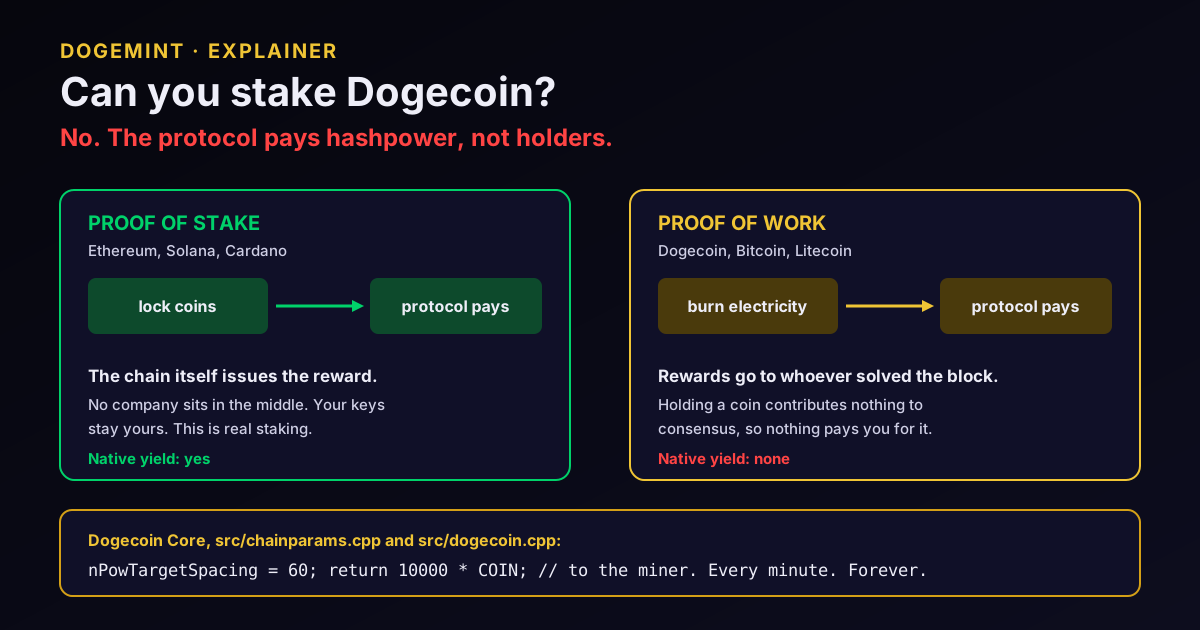
The answer, from the source code
You do not have to take anyone's word for this. Dogecoin Core is public, and two lines settle it.
In src/chainparams.cpp, the mainnet consensus block sets nPowTargetSpacing = 60, with the comment // 1 minute. PoW, right there in the variable name. In src/dogecoin.cpp, the function GetDogecoinBlockSubsidy handles the reward, and past block 600,000 it does exactly one thing: return 10000 * COIN;. The code comment above it reads // Constant inflation.
That subsidy goes to whoever produced the block. As of 2026-07-29 the chain is at block 6,309,962, so it has been running on that flat 10,000 rule for well over five million blocks. Nowhere in the consensus code is there a mechanism that reads a wallet balance and pays it anything. There is no staking function because there is no stake.
The current release is Dogecoin Core 1.14.9, published 2024-12-01. It is proof-of-work. So was 1.14.8, and so was every version before it.
So what are all those "stake DOGE" pages selling?
Four things, in roughly descending order of legitimacy. The common thread is that all four require you to give your DOGE to someone else.
| What it's called | What it actually is | Where the yield comes from | What you're exposed to |
|---|---|---|---|
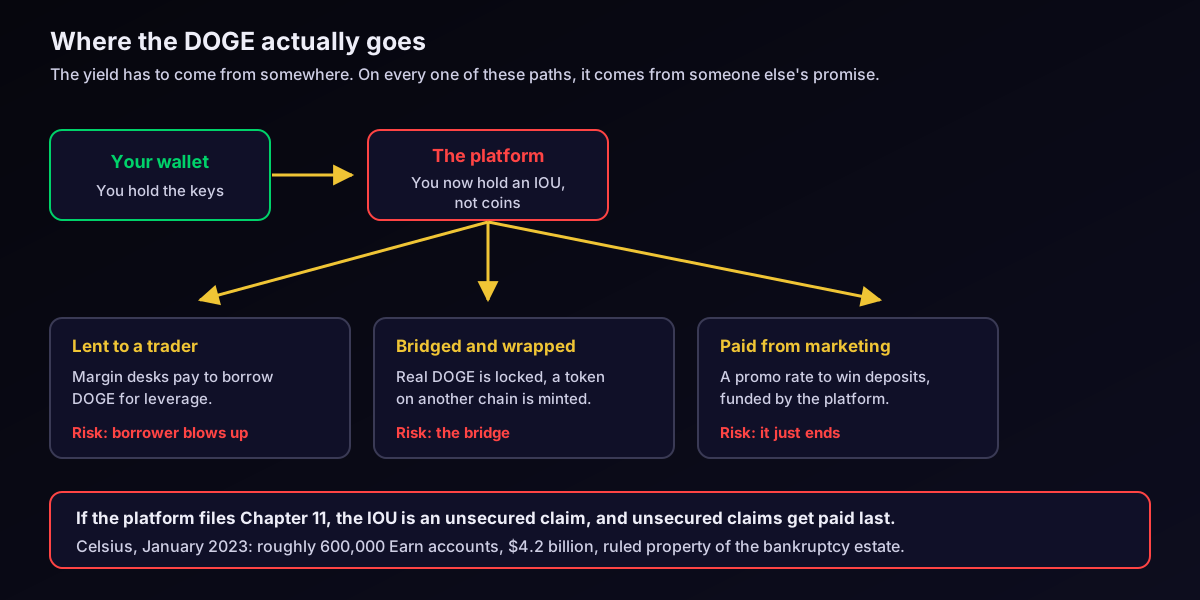
| "Soft staking" / Earn | A custodial deposit at an exchange | The exchange lends your DOGE to margin traders, or funds the rate from marketing | The exchange. You hold a balance in a database, not coins. |
| DOGE lending | An unsecured or partly collateralized loan you are making | Interest paid by borrowers who want leverage | Borrower default, and the lender's own solvency |
| Wrapped DOGE in DeFi | Real DOGE locked by a bridge, a synthetic token minted on Ethereum or BNB Chain | Liquidity mining or lending pools on the other chain | The bridge, the smart contract, the pool, and impermanent loss |
| "Staking pools" with big APYs | Frequently just a scam site | New deposits | Everything |
None of that is inherently fraudulent. Lending is a real business and interest is a real thing. But it is lending, and calling it staking hides the single most important fact about it.
The word every one of these pages omits: counterparty
Real staking on a proof-of-stake chain can be done without handing your coins to a company. The protocol pays you, the smart contract enforces the rules, and in the non-custodial case you never stop controlling the asset. That is why the SEC's Division of Corporation Finance was able to conclude, in its May 29, 2025 statement, that certain protocol staking activities are not securities offerings: the staker's role is "administrative or ministerial" rather than entrepreneurial. A follow-up statement on August 5, 2025 extended similar reasoning to certain liquid staking arrangements.
Every DOGE "staking" product fails that description at step one, because DOGE has no protocol staking for those statements to describe. What you're doing instead is transferring ownership of an asset to a company in exchange for a promise. That's a credit decision. And a credit decision demands the question nobody asks: who is borrowing my coins, what are they doing with them, and what happens to me if it goes wrong?
What "it goes wrong" looks like, in court
This is not a theoretical risk, and the definitive ruling is four years old.
On January 4, 2023, Judge Martin Glenn of the US Bankruptcy Court for the Southern District of New York decided who owned the crypto sitting in Celsius Network's Earn accounts. He found that under the plain language of Celsius's terms of use, depositors had transferred ownership to Celsius. The assets in roughly 600,000 Earn accounts, worth about $4.2 billion on the petition date, were property of the bankruptcy estate.
Depositors did not get their coins back. They got unsecured claims, which sit near the bottom of the payout order. The Arnold & Porter advisory on the ruling was titled, accurately, "Read Before You Click Accept."
Regulators had already said the same thing in a different register. In February 2022 the SEC charged BlockFi over its Interest Account product, settled for $100 million in penalties across the SEC and 32 states. In January 2023 it charged Genesis and Gemini over the Gemini Earn program. In February 2023 Kraken paid $30 million and shut down its US staking-as-a-service offering entirely. Every one of those was a custodial yield product on deposited crypto, which is precisely the category DOGE "staking" lives in.
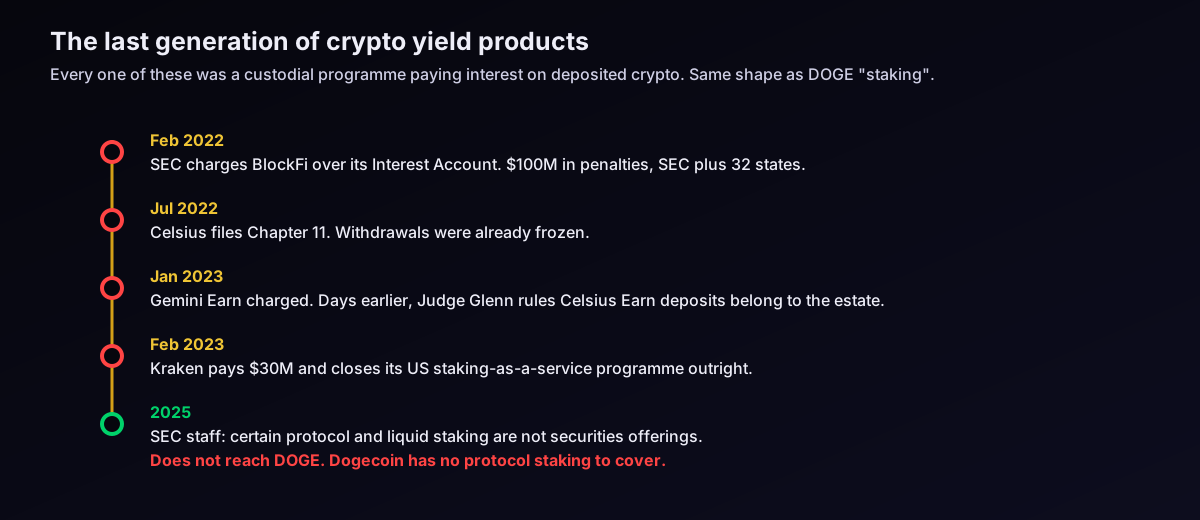
The regulatory mood has softened since, but softer rules do not make a lender solvent. Celsius was not a securities-law failure, it was a credit failure. The 2025 SEC statements have nothing to say about whether your borrower can pay you back.
Wrapped DOGE adds a second thing that can break
The DeFi path deserves its own warning. To earn yield on DOGE inside Ethereum or BNB Chain, the real DOGE has to be immobilized somewhere and a representative token minted on the other chain. That mechanism is a bridge, and bridges are the most reliably exploited component in crypto.
So the risk stack for "earning 9% on wrapped DOGE" is: the bridge custodian, the bridge contract, the DeFi protocol's contract, the pool's economics, and the DOGE price itself.
| Layer | What has to hold | If it doesn't |
|---|---|---|
| 1. The bridge custodian | Somebody actually holds the real DOGE that backs the wrapped token | The wrapper is unbacked and goes to zero |
| 2. The bridge contract | The minting and burning logic has no exploitable bug | Attacker mints tokens against nothing |
| 3. The DeFi protocol | The lending or liquidity contract behaves as audited | Pool drained, and there is nobody to appeal to |
| 4. The pool economics | Yield outruns impermanent loss and token emissions | Headline APY was never the real return |
| 5. DOGE itself | The price does not fall further than the yield earned | You earned 9% on an asset that fell 40% |
Five ways to lose, one way to earn 9%. Whether that trade is worth it is your call, but it should be made with the list in front of you rather than under the word "staking."
Four questions that kill most of these offers in five minutes
If you're still tempted by a rate, run it through these before you deposit anything. They're the questions a credit analyst would ask, which is the correct frame, because that's what you're doing.
| Ask them | A real answer sounds like | Walk away if |
|---|---|---|
| Where does the yield come from? | "We lend to institutional margin desks, overcollateralized at 130%." Specific and checkable. | "Our staking infrastructure generates rewards." For a coin with no staking, that is either confusion or hope that you are confused. |
| Who owns the coins while they sit there? | The terms say the assets remain yours and are held in segregated custody. | The terms transfer title, or grant a right to pledge, rehypothecate or lend. This exact clause decided Celsius. |
| What if the borrower doesn't pay? | Named collateral, held by a named third party, at a stated ratio. | "Insured" with no detail. Usually a custodian's crime policy for hot-wallet theft, which pays nothing when the failure is credit. |
| Can I get out on a Tuesday afternoon in a crash? | No lock-up, no discretionary pause clause, withdrawals tested at size. | A fixed term, or a clause letting them suspend withdrawals. Every failure in this category started with a pause, not an announcement. |
The tell that a DOGE staking page wasn't written by anyone who checked
Here is a fast filter. Several of the top-ranking "how to stake Dogecoin" guides advise readers to "look for slashing protection" and to "only use reputable validators."
Slashing is a proof-of-stake penalty. A validator that double-signs or goes offline gets a portion of its bonded stake destroyed by the protocol. Dogecoin has no bonded stake, no validators, and no slashing, so slashing protection on DOGE is protection against an event that cannot occur. It's a phrase copied from an Ethereum guide by someone who never opened the Dogecoin repo.
Rule: if a page recommends slashing protection for DOGE, close it. It's describing a coin it hasn't read about.
But didn't the Dogecoin Foundation announce staking?
It announced an intention, in December 2021, and that intention has not shipped.
The Dogecoin Trailmap, the Foundation's first public roadmap, described working with Vitalik Buterin on what it called a "community staking" version of proof-of-stake, framed as a design where ordinary holders rather than large players could earn for supporting the network, with a charitable component. Buterin had floated the idea publicly a few months earlier, and he was listed as a Foundation advisor.
Four and a half years later, the Trailmap's shipped projects are the ones you'd expect from a working chain: libdogecoin, GigaWallet, the Dogecoin Standard, and documentation. Nothing has been merged into Dogecoin Core that changes consensus. Core developers have said publicly that there is no plan to move to proof-of-stake, and a consensus change of that size on a chain secured by merged mining with Litecoin would be contested rather than routine.
The honest status as of July 2026: a proposal that generated headlines and no code. If it ever ships, the ground here changes completely. Until then, any site presenting DOGE staking as available today is wrong about a checkable fact.
The three honest ways to earn on DOGE
| Method | Does it pay? | The catch |
|---|---|---|
| Mining | Yes, in principle | Scrypt ASICs merged-mining with Litecoin own this. Consumer GPUs and CPUs lose money on electricity alone. See our 2026 mining piece. |
| Getting paid in DOGE | Yes | The income is your business, not the coin. And every DOGE you then spend is a taxable disposal. |
| Holding it | Only via price | No yield, by design. Your return is whatever the market does, which historically has been violent in both directions. |
| Lending it out | Yes, until it doesn't | This is the "staking" category. Real interest, real credit risk, no deposit insurance. |
Worth naming plainly: the demand for DOGE yield exists because holders watched a 90% drawdown from the May 2021 high and want the position to do something in the meantime. That's a completely reasonable feeling and a terrible reason to hand coins to a lender. We wrote about what actually moves the price in our 2026 read, and about the difference between a falling price and a failing network in the "is DOGE dead" piece.
If you were going to stake it, self-custody it instead
The counter-move to yield-chasing is boring and effective: hold your own keys. Coins in a wallet you control cannot be lent to a hedge fund, cannot be frozen during a withdrawal pause, and cannot become property of anyone's bankruptcy estate. Our 2026 wallet guide covers the options; the one thing worth spending money on is a durable backup of the recovery phrase.
Sources
- Dogecoin Core, src/chainparams.cpp (nPowTargetSpacing = 60; AuxPoW consensus at height 371337) · Dogecoin Project on GitHub, verified 2026-07-29
- Dogecoin Core, src/dogecoin.cpp (GetDogecoinBlockSubsidy returns a flat 10000 * COIN) · Dogecoin Project on GitHub, verified 2026-07-29
- Dogecoin Core releases (1.14.9, published 2024-12-01) · Dogecoin Project on GitHub, verified 2026-07-29
- Dogecoin Trailmap (December 2021 roadmap; shipped projects) · Dogecoin Foundation, verified 2026-07-29
- Statement on Certain Protocol Staking Activities, May 29, 2025 · SEC Division of Corporation Finance, verified 2026-07-29
- Statement on Certain Liquid Staking Activities, August 5, 2025 · SEC Division of Corporation Finance, verified 2026-07-29
- Judge Glenn's Celsius Earn ruling: deposits are estate property (600,000 accounts, $4.2B) · Arnold & Porter advisory, verified 2026-07-29
- BlockFi to pay $100 million over its crypto lending product, February 2022 · SEC, verified 2026-07-29
- Kraken to discontinue staking-as-a-service and pay $30 million, February 2023 · SEC, verified 2026-07-29
- DOGE price, supply and all-time-high drawdown · CoinGecko, verified 2026-07-29