Dogecoin taxes: how DOGE gains are actually taxed in the US
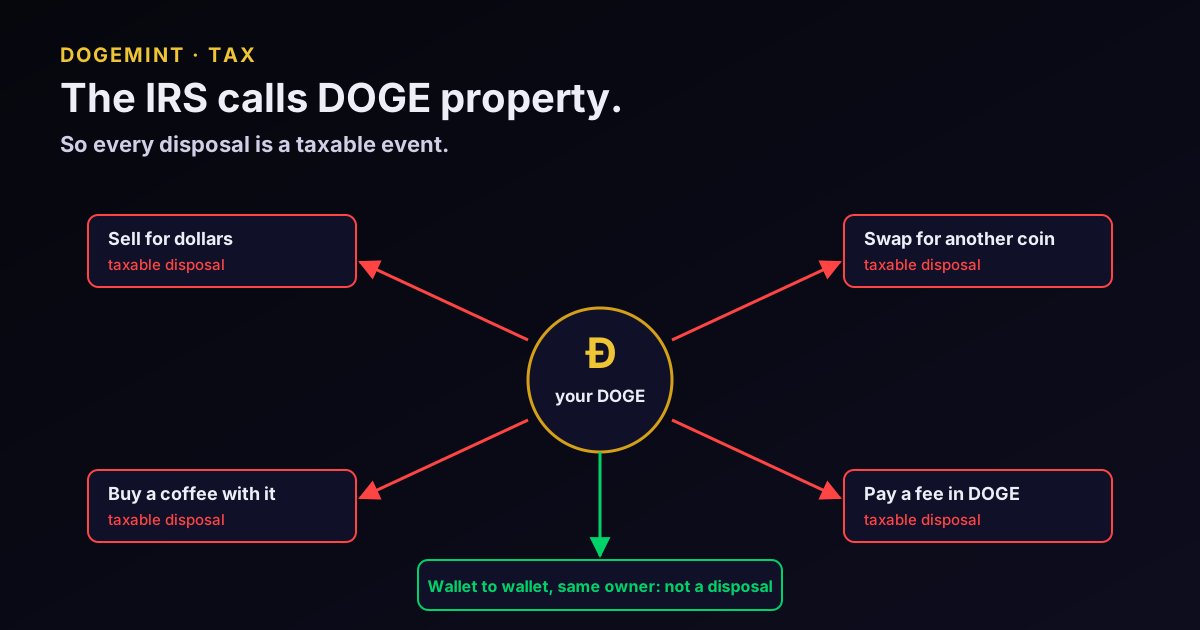
The IRS treats Dogecoin as property, not as money. That single classification decides everything else. Selling DOGE for dollars, swapping it for another coin, and buying a sandwich with it are all disposals of property, and each one produces a capital gain or loss you have to report. Hold for more than a year and the gain gets the long-term rate, which in 2026 tops out at 20% and starts at 0%. Hold for a year or less and it gets taxed like a paycheck. This is general information about how the rules work, not tax advice about your return. For your actual numbers, pay a CPA.
The one rule everything else hangs off
IRS Notice 2014-21 answered the question in eleven words. Q-1 asks how virtual currency is treated for federal tax purposes. A-1: "For federal tax purposes, virtual currency is treated as property." Twelve years and several revenue rulings later, that has not changed.
Property is the whole story. When you sell property you compare what you got against what you paid, and the difference is a capital gain or loss. Notice 2014-21 also says the opposite of what a lot of people assume: Q-2 confirms virtual currency is not treated as currency for foreign-currency gain purposes. There is no "it's just money moving around" exemption. DOGE behaves like a share of stock that happens to have a dog on it.
So the practical question is never "did I make money on DOGE." It is "did I dispose of any DOGE, and what did it cost me."
What counts as a taxable event, and what doesn't
People get this backwards constantly. Buying DOGE is not taxable. Holding it through a 300% run is not taxable. Moving it off an exchange into a hardware wallet is not taxable, because you still own the same coins. What triggers tax is parting with the coins.
| Action | Taxable? | What actually happens |
|---|---|---|
| Buy DOGE with USD | No | You establish cost basis. Nothing is reportable yet. |
| Hold while price rises or falls | No | Unrealized. The IRS does not tax paper gains on property. |
| Move DOGE between your own wallets | No | Same owner, no exchange. Keep the record anyway, see the wallet rule below. |
| Sell DOGE for USD | Yes | Capital gain or loss: proceeds minus basis. |
| Swap DOGE for SHIB, BTC, or a stablecoin | Yes | Q-16 of the IRS virtual currency FAQ: exchanging for other property, including another virtual currency, is a recognized gain or loss. |
| Buy goods or services with DOGE | Yes | Q-14: paying for a service with a capital asset is an exchange of that asset. |
| Pay a network or exchange fee in DOGE | Yes, technically | The fee itself is a disposal of a small amount of property. |
| Receive DOGE as a bona fide gift | No, on receipt | Q-31: no income until you sell, exchange or dispose of it. |
| Get paid in DOGE for work | Yes | Ordinary income at fair market value on the day received, per Notice 2014-21 Q-3. |
The row that costs people real money is the swap. Trading DOGE for another coin feels like rearranging the same pile, but the IRS reads it as selling DOGE at market value and immediately buying something else. If you rode DOGE from $0.02 to $0.20 and then rotated the whole position into SHIB, you owe tax on that ninefold gain in the year you rotated, in dollars, even though you never touched a dollar. Plenty of people learned this in April 2022 while holding a portfolio worth 80% less than the gain they owed on. We covered why the rotation urge is so strong in our DOGE versus SHIB comparison.
The one-year line decides your rate
Q-6 of the IRS virtual currency FAQ sets the boundary: held one year or less is short-term, held more than one year is long-term. Short-term gains stack onto your ordinary income and get taxed at your marginal rate. Long-term gains use a separate, much friendlier schedule.
Here are the actual 2026 numbers, from Revenue Procedure 2025-32. These are taxable-income figures, meaning after your standard deduction, which for 2026 is $16,100 single and $32,200 married filing jointly.
| 2026 long-term rate | Single | Married filing jointly | Head of household |
|---|---|---|---|
| 0% | Up to $49,450 | Up to $98,900 | Up to $66,200 |
| 15% | $49,450 to $545,500 | $98,900 to $613,700 | $66,200 to $579,600 |
| 20% | Above $545,500 | Above $613,700 | Above $579,600 |
| 2026 ordinary rate (short-term gains) | Single | Married filing jointly |
|---|---|---|
| 10% | Up to $12,400 | Up to $24,800 |
| 12% | $12,400 to $50,400 | $24,800 to $100,800 |
| 22% | $50,400 to $105,700 | $100,800 to $211,400 |
| 24% | $105,700 to $201,775 | $211,400 to $403,550 |
| 32% | $201,775 to $256,225 | $403,550 to $512,450 |
| 35% | $256,225 to $640,600 | $512,450 to $768,700 |
| 37% | Above $640,600 | Above $768,700 |
Long-term gains stack on top of your ordinary income rather than replacing it, which is the part people misread. If you already have $200,000 of salary, none of your DOGE gain lands in the 0% band.
What the one-year line is worth in dollars
Say you're single, you have $40,000 of taxable income from a job, and you have a $20,000 gain in DOGE. Same coins, same gain, two different sale dates.
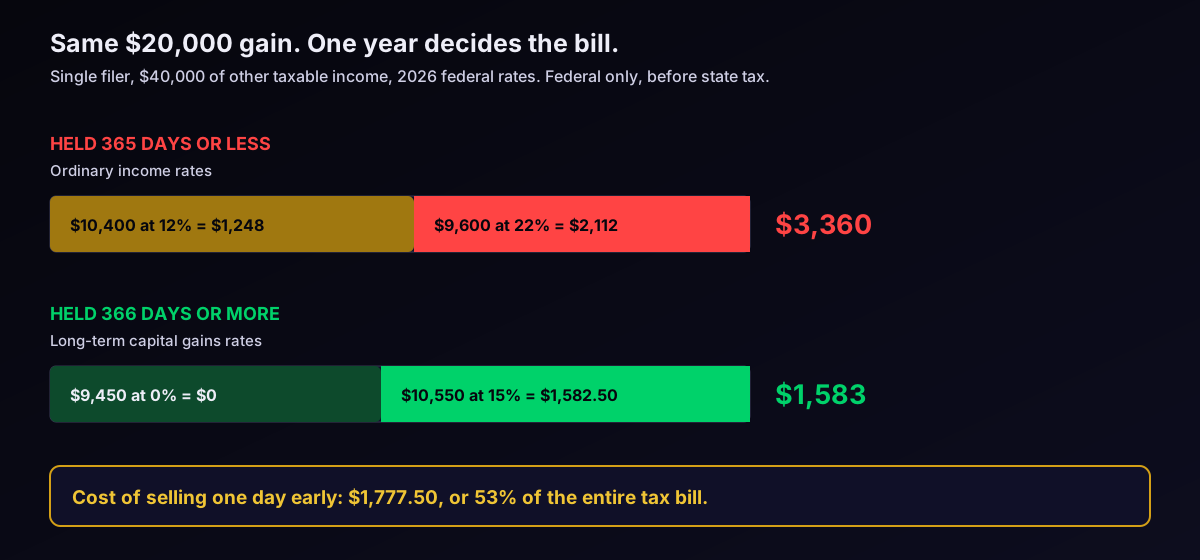
Sell at month eleven and the $20,000 piles onto your $40,000, filling the rest of the 12% bracket up to $50,400 and then spilling into 22%. That's $1,248 plus $2,112, or $3,360.
Sell at month thirteen and the gain gets the long-term schedule. Your ordinary income sits at $40,000, the 0% band runs to $49,450, so $9,450 of the gain is taxed at nothing at all. The remaining $10,550 gets 15%, for $1,582.50.
Rule: two extra days of patience were worth $1,777.50. That is a bigger swing than most people ever get from picking a better entry price, and it requires no skill at all.
Mined DOGE gets taxed twice, in a sense
If you're pointing hash at the chain, the tax treatment is different and worse. Notice 2014-21 Q-8 asks whether a miner realizes gross income on receipt. A-8: yes, "the fair market value of the virtual currency as of the date of receipt is includible in gross income."
So a block reward is ordinary income the moment it lands, valued in dollars at that moment, at your ordinary rate. That dollar amount then becomes your cost basis in those coins. When you eventually sell them, the difference between the sale price and that basis is a separate capital gain or loss. Two events, two calculations, on every reward.
Q-9 adds the other shoe. If your mining rises to a trade or business rather than a hobby, the net earnings are self-employment income and carry self-employment tax on top. Given DOGE's merged-mining structure, most people reading this are getting payouts from a Scrypt pool rather than solo-mining blocks, but the treatment is the same: value on receipt, ordinary income, then capital gain on disposal. Our 2026 mining article covers whether any of that is worth doing on consumer hardware, and the short answer is no.
Form 1099-DA is here, and the number on it is not your gain
Until recently there was no digital asset information return at all. That ended with Treasury Decision 10000 and the new Form 1099-DA, "Digital Asset Proceeds From Broker Transactions." Brokers must report gross proceeds for sales effected on or after January 1, 2025, and basis reporting for covered assets phases in for sales on or after January 1, 2026.
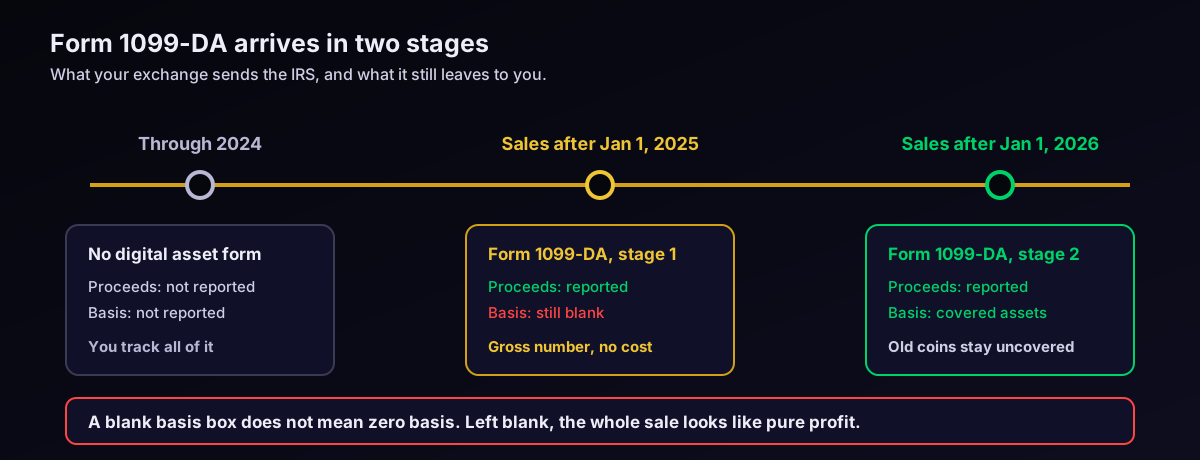
Two things about that form matter more than anything else on it.
First, the proceeds figure is not your income. It is the gross number. Your gain is proceeds minus basis, and in the transition period the basis box is frequently empty. The IRS says it plainly on its own explainer page: "You must calculate basis before you file your tax return." If you file off the 1099-DA headline number, you will overpay, sometimes dramatically.
Second, an absent form proves nothing. The IRS position is that "whether or not you receive a Form 1099-DA, you must report all income, gains and losses from digital asset transactions." Self-custody transfers, peer-to-peer sales, and DOGE spent directly at a merchant generate no broker form and are still fully reportable. The Form 1040 digital asset question sits above the signature line, and answering it wrongly is a separate problem from answering it late.
Where does all this land on the actual return? Capital gains and losses go on Form 8949 and flow to Schedule D. Mining, staking rewards, forks and airdrops go to Schedule 1. If it's a trade or business, Schedule C.
The wallet-by-wallet rule nobody mentioned to you
This one is quiet and expensive. For years, taxpayers commonly tracked basis "universally," treating everything they owned as one big pool no matter which exchange or wallet held it. Revenue Procedure 2024-28 ended that. Basis has to be tracked per wallet and per account, each treated as its own ledger, with FIFO as the default if you don't specifically identify units.
Specific identification is still permitted. Q-39 of the IRS virtual currency FAQ says you may choose which units are deemed sold "if you can specifically identify which unit or units of virtual currency are involved in the transaction and substantiate your basis in those units." The word doing the work there is "substantiate." That means records made at the time, not a reconstruction in March.
The practical consequence: if you have DOGE at Coinbase, DOGE at Kraken, and DOGE in a self-custody wallet, those are three separate ledgers now. The cheap coins from 2019 do not offset the expensive coins from 2021 unless they were in the same account. Rev. Proc. 2024-28 offered a one-time allocation safe harbor to sort out pre-2025 holdings, which is now behind us.
Losses, the $3,000 cap, and the wash-sale gap
Capital losses offset capital gains first, without limit. If losses exceed gains, you can deduct up to $3,000 of the excess against ordinary income per year ($1,500 if married filing separately), and carry the rest forward indefinitely until it's used up. That carryforward has no expiration, which is worth remembering if you took a bath in a previous cycle.
Then there's the gap. Section 1091, the wash sale rule, applies to "stock or securities." The IRS treats DOGE as property rather than a security, so as of July 2026 selling DOGE at a loss and buying it straight back generally leaves the loss deductible, where the identical move with a stock would disallow it for 30 days. Bills to extend the rule to digital assets have been introduced repeatedly since 2021 and none has become law.
Two cautions before anyone gets excited. Crypto ETFs and crypto-related equities are securities, and the rule applies to them normally. And a gap that has survived on legislative inertia can close in any tax bill, possibly with an effective date that isn't the one you planned around. Treat it as a current fact, not a permanent feature.
What to actually keep
Most DOGE tax pain is a records problem wearing a tax costume. The rules above are not complicated. Reconstructing four years of transactions across three exchanges and a phone wallet, in April, is.
| Keep for every transaction | Why it matters |
|---|---|
| Date and time acquired | Decides short-term versus long-term, which is the single biggest lever on your bill. |
| USD value at acquisition, plus fees | This is your basis. Q-8 of the IRS FAQ includes fees, commissions and other acquisition costs. |
| Which wallet or account it lived in | Required since Rev. Proc. 2024-28. Basis is per-account now. |
| Date and USD value at disposal | Your proceeds. Needed even when the counterparty was a merchant, not an exchange. |
| Transfer records between your own wallets | Not taxable, but without them a transfer out looks exactly like a sale. |
| Annual CSV export from every exchange | Exchanges delist coins, close accounts, and go under. Export yearly, not when you need it. |
If you spend DOGE regularly, the arithmetic gets tedious fast, because every purchase is its own disposal with its own basis lot. That is the honest cost of using a volatile property as a payment method, and it is a real argument against doing it casually. We laid out the merchant side of that tradeoff in the 2026 spending guide. If you want something that doesn't move, you want a stablecoin, and we explained why DOGE isn't one in this piece.
Where this article stops
Everything above is how the rules read. What it isn't is advice about your situation, and the gap between those two is where people get hurt. State treatment varies and is not covered here at all. Large positions, mining operations, gifts above the annual exclusion, charitable donations of appreciated DOGE, estate questions, and anything involving a business entity all need a professional who has seen your actual numbers.
A CPA who handles digital assets costs a few hundred dollars and routinely finds more than that in basis you forgot you had. That is not a hedge, it's arithmetic.
Reading material
Next, two questions that come up right after this one: whether there's a way to earn on DOGE without selling it (there isn't, and here's what those products really are), and how DOGE's economics compare to the asset everyone benchmarks against (Dogecoin versus Bitcoin).
Sources
- IRS Notice 2014-21 (virtual currency as property; Q-1, Q-2, Q-3, Q-8, Q-9) · Internal Revenue Service, verified 2026-07-29
- IRS FAQ on virtual currency transactions (Q-6 holding period, Q-8 basis, Q-14 spending, Q-16 crypto-to-crypto, Q-31 gifts, Q-39 specific identification) · Internal Revenue Service, verified 2026-07-29
- IRS Digital Assets hub (forms, the Form 1040 digital asset question, reporting map) · Internal Revenue Service, verified 2026-07-29
- Understanding your Form 1099-DA ("You must calculate basis before you file") · Internal Revenue Service, verified 2026-07-29
- Instructions for Form 1099-DA (broker definition, covered-asset reporting) · Internal Revenue Service, verified 2026-07-29
- T.D. 10000, gross proceeds and basis reporting by brokers for digital asset transactions · Federal Register, verified 2026-07-29
- Revenue Procedure 2025-32 (tax year 2026 rate schedules and capital gains breakpoints) · Internal Revenue Service, verified 2026-07-29
- IRS release: tax year 2026 inflation adjustments (2026 brackets and standard deduction) · Internal Revenue Service, verified 2026-07-29
- Topic no. 409, Capital gains and losses ($3,000 limit, carryover) · Internal Revenue Service, verified 2026-07-29
- Rev. Proc. 2024-28: universal basis tracking ends, wallet-by-wallet begins · The Tax Adviser (AICPA), verified 2026-07-29