Best meme coins in 2026, ranked on things you can actually check
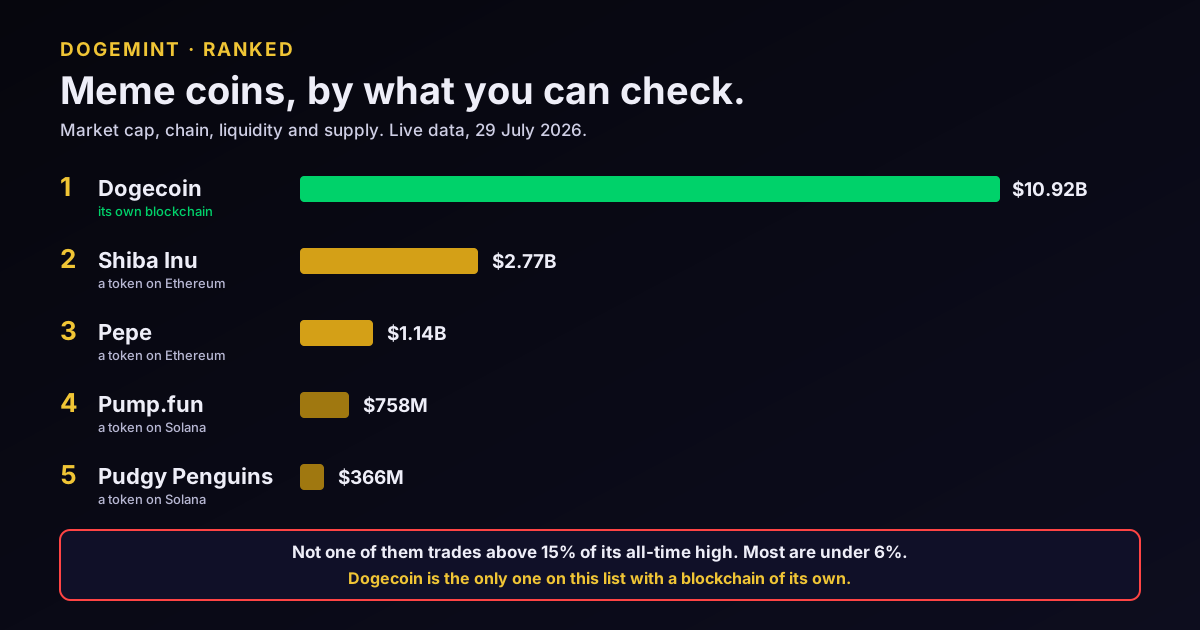
Ranked on five things you can verify yourself: market capitalisation, whether the coin has its own blockchain, how much of it actually trades, supply mechanics, and how far it sits below its own peak. Not on where the price is going, because nobody knows that and anyone who says otherwise is selling something. One number frames everything below. On 29 July 2026, not a single major meme coin traded above 15% of its all-time high, and most are below 6%. This is a ranking of survivors in a category where survival is the exception.
What this ranking measures, and what it cannot
Worth being blunt about this before the table, because most "best meme coin" lists quietly rank on the author's holdings.
What is measured here: size, liquidity, chain independence, supply transparency, and how long the thing has survived. All of it is observable today and none of it requires a forecast.
What is not measured: future returns. This is not a prediction and there are no price targets anywhere in this article. A coin ranking first here is the most established, which is a different claim from being the best thing to buy. In a category this volatile the largest asset is often the one with the least room to multiply, so "ranked first" and "best investment" may well point in opposite directions.
What cannot be measured at all: survivorship. Every coin below is a winner by definition, because it is big enough to be listed and quoted. The thousands of tokens that went to zero are not in any dataset, so every ranking of this category, including this one, is systematically flattering. Hold that thought while reading the drawdown numbers, because they are already grim before you correct for it.
The ranking
| # | Coin | Market cap | Chain | Supply | 24h volume vs cap | Below peak |
|---|---|---|---|---|---|---|
| 1 | Dogecoin (DOGE) | $10.92B | Its own | Uncapped, 5.256B a year | 4.3% | 90.4% |
| 2 | Shiba Inu (SHIB) | $2.77B | Ethereum | Uncapped in code | 5.0% | 94.5% |
| 3 | Pepe (PEPE) | $1.14B | Ethereum | Fixed, 420.69T | 11.8% | 90.3% |
| 4 | Pump.fun (PUMP) | $758M | Solana | Capped, 1T | 9.2% | 78.3% |
| 5 | Pudgy Penguins (PENGU) | $366M | Solana | Capped, 88.9B | 11.5% | 91.5% |
| 6 | Official Trump (TRUMP) | $355M | Solana | Capped, 1B | 16.1% | 98.1% |
| 7 | Bonk (BONK) | $256M | Solana | Capped, 88T | 13.5% | 95.0% |
| 8 | FLOKI | $196M | Ethereum, BNB | Capped, 20T | 5.9% | 94.1% |
| 9 | dogwifhat (WIF) | $145M | Solana | Fixed, 999M | 14.2% | 97.0% |
| 10 | Fartcoin | $122M | Solana | Capped, 1B | 10.2% | 95.1% |
Dogecoin is larger than the other nine put together, roughly twice over. It is also the only entry in the overall top 20 of all cryptocurrencies, sitting 11th. Shiba Inu is 31st. After that the category falls off a cliff into the triple digits.
The liquidity screen, which removes several apparent giants
This is the part of the exercise that produced something genuinely surprising, and it is the reason the ranking above is not simply the CoinGecko meme-coin list in order.
A market capitalisation is price multiplied by a supply figure. Both inputs can be soft. If the supply number is self-reported and almost nobody is trading, the market cap is arithmetic rather than information. So the screen is simple: how much did it actually trade in 24 hours, relative to what it claims to be worth?
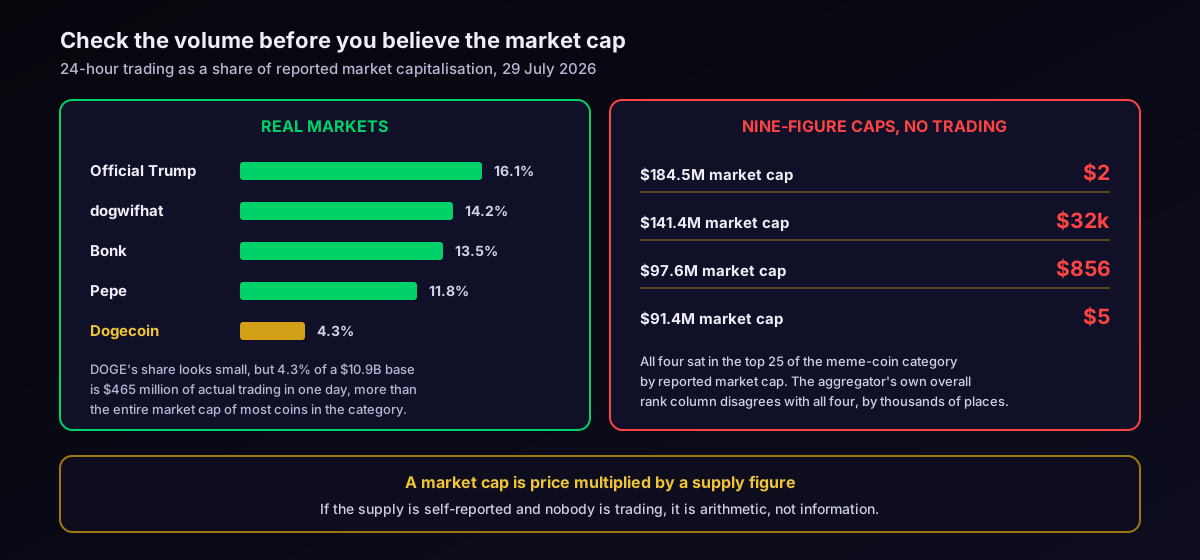
The healthy end looks like this: Official Trump turned over 16.1% of its market cap in a day, dogwifhat 14.2%, Bonk 13.5%, Pepe 11.8%. Dogecoin's 4.3% looks low next to those, but on a $10.9 billion base that is $465 million of real trading, which is more than the entire market cap of most entries on the list.
Then there is the other end. Four tokens appeared in the top 25 by reported market cap with numbers like these:
- One with a $184.5 million reported market cap and $2 of 24-hour volume.
- One with a $97.6 million reported market cap and $856.
- One with a $91.4 million reported market cap and $5, whose recorded all-time high sits below its current price, which is internally impossible and tells you the price history is not reliable either.
- One with a $141.4 million reported market cap and about $32,000.
The tell is that CoinGecko's own overall rank column disagrees with the market-cap sort for exactly these tokens. One shows a market cap that would place it around 160th while its listed rank is 12,768th. The aggregator is flagging that it does not trust the number, in the only way a data column can.
Rule: before you believe a market cap, check the volume. It takes ten seconds and it removes a surprising fraction of any "top meme coins" list you will read this year, including lists that copied their ordering from the same API without looking.
Everything is down, and by more than you think
This chart is the most useful thing on the page, and it is the one no promotional article about the category will show you.
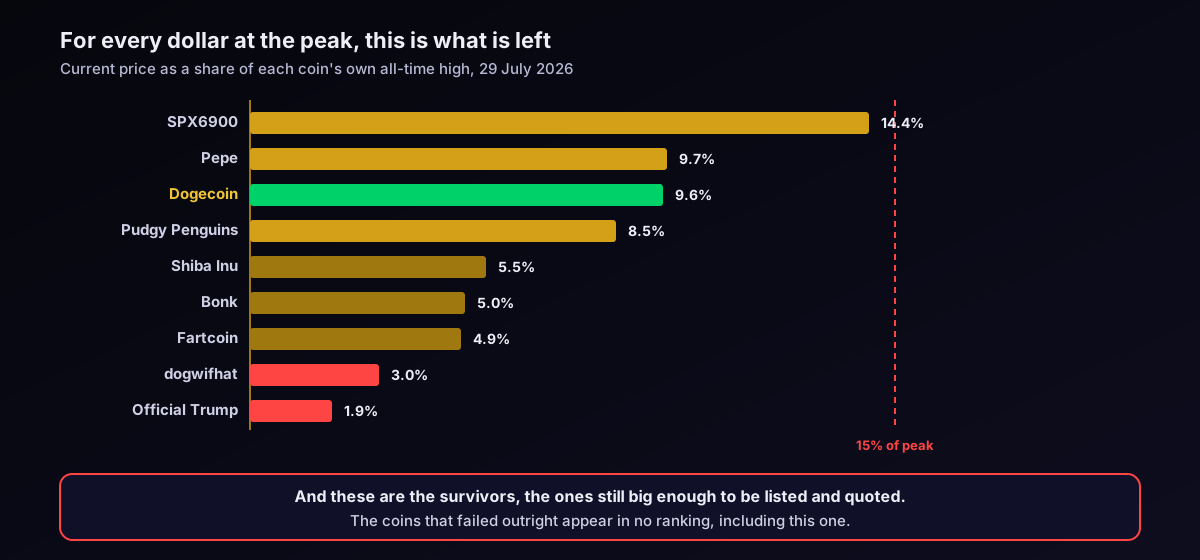
Read it as: for every dollar at the peak, this is what is left. Dogecoin retains about 9.6 cents of its May 2021 dollar, and it is one of the better performers. Shiba Inu retains 5.5 cents. Bonk 5 cents. dogwifhat 3 cents. Official Trump, which peaked at $73.43 on 19 January 2025 and traded at $1.43 on the day this was written, retains under 2 cents on the dollar.
Two things follow, and they pull in opposite directions, which is why honest people disagree here.
The bear reading: these assets do not recover. Dogecoin's peak was more than five years ago and it has not come close since. A drawdown that deep and that persistent is not a dip, it is a repricing.
The bull reading, stated fairly: every one of these is also up enormously from its own launch, and drawdown from a mania peak is a strange denominator to judge an asset by. Dogecoin at $0.070 is still worth roughly 800 times what it traded at in 2015. Both statements are true. Which one matters depends entirely on when you bought, which is a fact about you rather than about the coin.
Why Dogecoin ranks first, and the honest case against it
DOGE takes the top slot on four of the five criteria, and one of them is structural rather than a matter of degree.
It is the only major meme coin with its own blockchain. Everything else on the list is a token on Ethereum, Solana or BNB Chain. That means the others inherit their host's fees, congestion, outages and governance, and have no independent existence at all. Dogecoin has its own Scrypt miners, its own 60-second blocks and its own fee policy, which we pulled apart in the fee piece. It has also been merge-mined with Litecoin since 2014, which buys it security it could never pay for alone.
It is also twelve and a half years old, has survived multiple complete cycles, is on every major exchange, and is the only one of these with US spot ETFs, which we covered in the ETF piece. On any measure of establishment it wins comfortably.
Now the case against it, which is real and which the ranking does not capture.
Dogecoin has the worst supply mechanics on this entire list. Pepe's supply is fixed at 420.69 trillion and will never change. dogwifhat's is fixed. Fartcoin, Bonk, PENGU and TRUMP all have hard caps. Dogecoin issues 10,000 new coins every minute, forever, with no cap and no halving ever again, which is 5.256 billion new coins a year, about 3.4% annual dilution against every holder. If you are ranking these on monetary discipline alone, Dogecoin finishes near the bottom, not the top. That arithmetic is laid out in Dogecoin versus Bitcoin.
So the ranking is measuring durability, not scarcity, and those are genuinely different questions. Someone who cares most about a fixed supply would reasonably rank Pepe first and Dogecoin sixth. That is a defensible position and I am not going to pretend otherwise.
Notes on the rest
Shiba Inu is the only one that seriously attempted to become infrastructure rather than a ticker, with its own layer-2 and token ecosystem. It is also 94.5% below a peak set in October 2021 and has spent four and a half years not recovering. The head-to-head is in DOGE versus SHIB.
Pepe has the cleanest supply story on the list and the second-best liquidity of the large entries. It has no chain, no utility claim and no pretence of one, which its holders consider the point.
Pump.fun is an odd inclusion and worth flagging. It is the token of the platform that industrialised meme coin issuance, so it is less a meme coin than a bet on the volume of meme coin creation. Its 78.3% drawdown is the shallowest here, mostly because it launched in 2025 and has had less time to fall.
Official Trump is the cautionary tale of the category. It peaked at $73.43 within days of launching in January 2025 and now trades at $1.43. Anyone who bought in the first week and held is down 98%. It still has the highest turnover on the list, which is what a permanently active exit queue looks like.
MemeCore is absent from the ranking despite a $1.53 billion reported market cap, third-largest in the category, because it turned over just 0.66% of that in 24 hours. That does not make it fraudulent and I am not saying it is. It does mean the market cap is not corroborated by trading the way the others are, so I left it out of a ranking whose whole premise is verifiability rather than quietly listing it third.
How to check any meme coin in five minutes
This is the transferable part. The specific coins will change; the checks will not.
| Check | Where | Bad sign |
|---|---|---|
| Volume against market cap | Any price aggregator | Under about 1%. The cap is not corroborated by trading. |
| Aggregator rank vs cap position | Same page | They disagree wildly. The supply figure is self-reported. |
| Holder concentration | The chain's block explorer | A handful of wallets hold most of it |
| Which chain, and is it a token | Contract address on the listing | Multiple unaudited bridged versions |
| Supply cap and mint authority | Contract, or the project's docs | Mint function still live, or no stated cap |
| Drawdown from its own high | The price page | Not a bad sign by itself, but know the number before you buy |
| Age | Listing date | Under a full market cycle means it is untested |
The last word belongs to the survivorship problem. Every coin in this article cleared a very high bar just to be measurable, and they are collectively down 78% to 98% from their peaks. The full distribution of this category, including everything that failed, is far worse than the table shows. Treat any meme coin position as money you have decided you can lose entirely, because the base rate says most of them do. If you want the argument about whether the largest one is finished, we wrote it up in the reality check, and the buying mechanics are in how to buy DOGE in 2026. Whatever you hold, the scam guide covers the ways people lose it that have nothing to do with price.
Reading material
Sources
- CoinGecko markets API, meme-token category · every market cap, price, 24-hour volume, all-time high and all-time-high date used above, including the low-volume outliers and the rank-versus-cap discrepancies · CoinGecko, retrieved 2026-07-29
- Dogecoin: $10.92B market cap, rank 11, $465.4M 24h volume, all-time high $0.731578 on 2021-05-07 · CoinGecko, verified 2026-07-29
- Shiba Inu: $2.77B market cap, rank 31, all-time high $0.00008616 on 2021-10-27 · CoinGecko, verified 2026-07-29
- Pepe: $1.14B market cap, fixed maximum supply of 420,690,000,000,000, all-time high 2024-12-09 · CoinGecko, verified 2026-07-29
- Official Trump: $355M market cap, all-time high $73.43 on 2025-01-19, price $1.43 · CoinGecko, verified 2026-07-29
- dogwifhat: $145M market cap, all-time high $4.83 on 2024-03-31 · CoinGecko, verified 2026-07-29
- Dogecoin Core, GetDogecoinBlockSubsidy: a constant 10,000 DOGE per block past block 600,000 · the source of the 5.256 billion a year and 3.4% dilution figures · Dogecoin Project on GitHub, verified 2026-07-29
- Dogecoin Core chainparams: nPowTargetSpacing 60, auxiliary proof of work effective at block 371,337 · the basis for the "own chain, merge-mined with Litecoin" claim · Dogecoin Project on GitHub, verified 2026-07-29
- Blockchair Dogecoin network statistics · corroborates DOGE's independent chain activity: 1,363 blocks and 26,461 transactions in 24 hours · Blockchair, verified 2026-07-29