Dogecoin scams to avoid in 2026
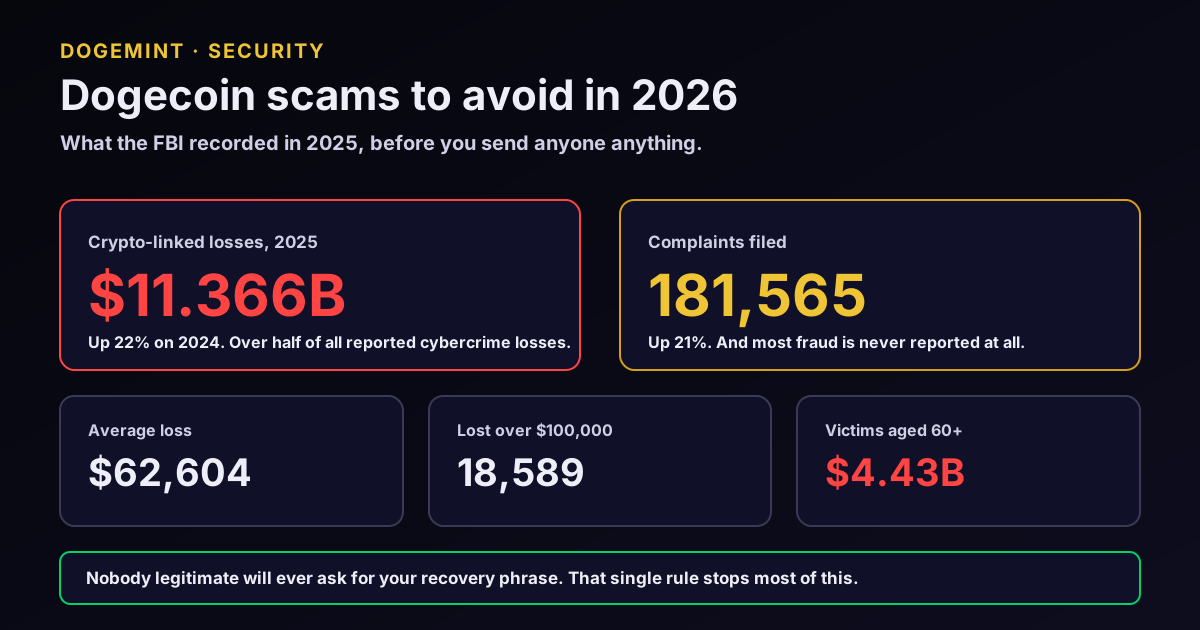
Americans reported $11.366 billion in cryptocurrency-linked losses to the FBI in 2025, across 181,565 complaints, with an average loss of $62,604. That is more than half of all internet crime losses recorded that year. Dogecoin holders get a specific slice of this because DOGE is cheap, famous, easy to send, and permanently attached to a celebrity. Here are the nine patterns that actually target you, what each one looks like when it arrives, and the four rules that would have stopped nearly all of it.
The number that should change how you talk to your family
Losses do not spread evenly across age groups. They concentrate hard at the top end, and not because older people file more complaints.
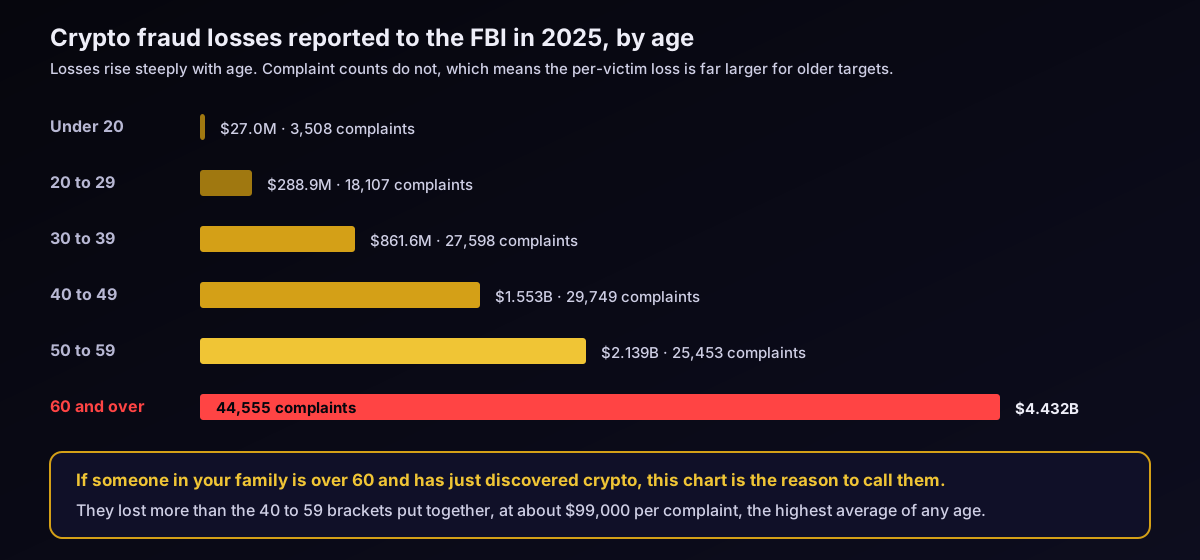
The 60-and-over bracket lost more than the 40-to-49 and 50-to-59 brackets combined. If someone in your family recently got interested in crypto and is in that group, forwarding this article is a more useful intervention than anything else in it.
Why crypto is the scammer's preferred rail
A confirmed Dogecoin transaction cannot be reversed. Not by you, not by the recipient, not by an exchange, not by the Dogecoin developers, not by a court. There is no chargeback mechanism, no issuing bank, and no FDIC. That finality is a feature of the technology and it is exactly what makes it attractive to thieves.
The FBI's transaction-type data makes the preference visible. In 2025, cryptocurrency was the reported payment method in 72% of investment fraud complaints and 31% of confidence and romance fraud complaints. Investment fraud alone accounted for $8.65 billion of reported losses, the largest single category by a distance.
Add the second reason: crypto scams scale. A wire fraud needs a mule account per victim. A DOGE address needs nothing, works globally, and can be posted to a million people at once.
The nine that actually target DOGE holders
| Scam | How it opens | The ask | The tell |
|---|---|---|---|
| Doubling giveaway | A post or livestream from "Elon Musk" | Send DOGE, get 2x back | You have to pay first. Always fatal. |
| DOGE agency mix-up | Email or text about a government payout | Personal details, or a wallet address | No US agency pays refunds in crypto. |
| Relationship investment fraud | A wrong-number text, a dating app | Deposit on "their" trading platform | They move you to WhatsApp and never meet. |
| Seed phrase phishing | Fake wallet app, support DM, "sync" page | Your 12 or 24 recovery words | Anyone asking is stealing. No exceptions. |
| Clipboard hijacking | Malware from a cracked app or bad download | Nothing. It swaps the pasted address | Pasted address differs from what you copied. |
| Cloud mining | Slick site promising daily DOGE returns | Upfront "contract" payment | Fixed daily returns on a variable-yield activity. |
| Crypto ATM / kiosk | A phone call creating urgency | Cash into a kiosk, QR code provided | Any caller directing you to a kiosk. |
| Fake support | Search ad, or a reply to your public complaint | Remote access, or a "verification" deposit | Support replying to you first. |
| Recovery scam | Contact after you were already scammed | Retainer, tracing fee, "release tax" | Any upfront fee to get money back. |
1. The doubling giveaway
The oldest DOGE scam and still the most common. Send DOGE to an address, receive double back, allegedly courtesy of Elon Musk, Tesla, SpaceX or a "verified community event." It persists because the celebrity association is real, which makes the pitch plausible in a way that a fake Coca-Cola giveaway never would be.
The production values have improved enormously. Expect a hijacked YouTube channel running a looped video of a real interview, a countdown timer, a wall of fake confirmations, and a QR code. None of that changes the arithmetic: no blockchain has a function that returns more than you sent, and nobody giving money away needs yours first. If you want the actual history of Musk's DOGE involvement, we documented it in the timeline, and none of it involves sending strangers coins.
2. The DOGE and Dogecoin mix-up
This one is specific to this coin and it has been unusually effective. The US Department of Government Efficiency shares an abbreviation with Dogecoin and nothing else. Scammers have run both directions of the confusion: emails claiming to come from an "assigned personal agent from the Department of Government Efficiency (DOGE)" authorized to issue tax refunds out of recovered government funds, sent to roughly 1,800 addresses and more than 350 organizations, and text messages telling recipients they qualify for a $5,000 federal subsidy funded by budget savings.
The clarifying facts: no federal agency issues refunds in cryptocurrency, no agency texts citizens about a payout, and no agency needs a wallet address. The FTC recorded about $920 million in reported losses to government impersonators in 2025, up from $789 million in 2024.
3. Relationship investment fraud
The category the industry calls pig butchering and the CFTC calls online financial romance fraud. It's slow, patient, and the single most expensive thing on this list per victim. Contact starts with a wrong-number text or a dating app, becomes a genuine-feeling friendship over weeks, and eventually turns to trading.
The CFTC publishes six warning signs, and they're worth reading as a checklist because they describe the script precisely:
| CFTC warning sign | What it's actually doing |
|---|---|
| Wants to move the conversation to a private messaging app | Escapes the dating app's moderation and reporting tools |
| Messages frequently but can never meet in person | The person in the photos does not exist and is not in your country |
| Claims to be wealthy from crypto or currency trading | Establishes the pretext before the ask, weeks in advance |
| Recommends a trading site that only accepts crypto | Removes every reversible payment rail from the transaction |
| Tells you to send funds to their wallet or that platform | The actual theft. Everything before this was setup. |
| You make a lot of money, quickly and easily | The balance is a number on a web page they control |
That last one is the cruel part. The platform is fake and the balance is a number on a webpage, so it can show whatever they want. The CFTC describes the endgame plainly: you're encouraged to withdraw a little and reinvest more, then "locked out" and required to pay fake fees or taxes to release your funds, and then the scammer vanishes. Nearly 60% of romance scam losses reported to the FTC in 2025 began on a social media platform.
4. Seed phrase phishing
Your recovery phrase is not a password. It is the wallet. Anyone holding those words controls every coin in it, forever, from anywhere, and there is no reset.
The requests arrive dressed up: a "wallet migration," a "network upgrade requiring resync," a support agent who needs it to "restore your balance," a validator tool, a fake Dogecoin Core download, an airdrop claim page. Some are convincing enough to fool careful people.
Rule: any request for your recovery phrase, in any wording, from any source, is theft in progress. There is no legitimate exception, ever. Nobody needs it. Not support, not developers, not the Foundation. Our wallet guide covers where the phrase should actually live, which is offline and on something that survives a house fire.
5. Clipboard hijacking
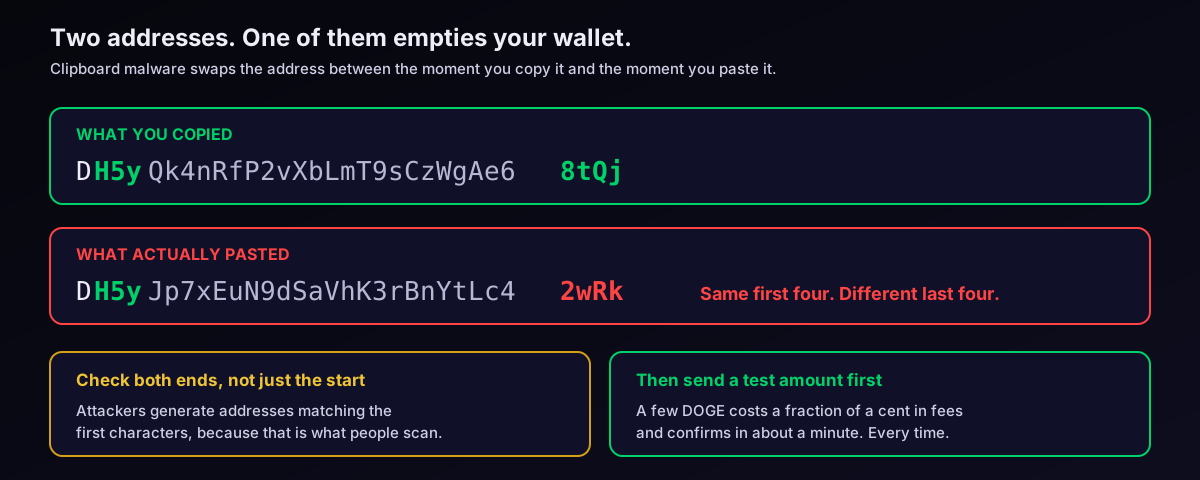
Less famous than the rest, and it costs people their entire balance in one keystroke. Malware sits on the machine watching the clipboard, recognizes a copied DOGE address, and silently replaces it with the attacker's before you paste. You paste, you glance at it, it looks like a normal address, and you send.
The defence is mechanical: after pasting, compare the first four and last four characters against the source, every single time, including on transfers you have done a hundred times. Then send a small test amount before a large one. Two seconds and a fraction of a cent in fees.
6. Cloud mining contracts
Pay upfront, receive DOGE daily from a hashrate contract, no hardware required. The problem is structural: mining revenue swings with price, difficulty and the merged-mining economics of Litecoin, so any operator promising a fixed daily return is either absorbing that risk out of charity or paying earlier customers with later deposits. Legitimate hosted mining does exist and it never advertises a guaranteed yield. We went through the real economics in the 2026 mining article.
7. Crypto ATMs and kiosks
A growth area, and a nasty one. In 2025 the FBI logged 13,460 complaints involving crypto ATMs and kiosks, with $389 million in losses, a 58% jump in losses on the year. Victims aged 60 and over accounted for $257 million of that, roughly two thirds.
The kiosk is never the scam by itself. It's the payment step at the end of a phone call: a fake fraud alert from "your bank," a fake warrant from "the sheriff's office," a tech support charge. The mark is told to withdraw cash and feed it into a machine, scanning a QR code the caller provides.
Rule: nobody legitimate will ever direct you to a crypto kiosk over the phone. Not your bank, not the police, not the IRS, not Microsoft.
8. Fake support
Two delivery routes. Search ads that outrank the real exchange for "[exchange] support number." And accounts that watch public complaints and reply within minutes when you post that you're locked out. Tech and customer support fraud drove $2.13 billion in reported losses in 2025, and 17,355 crypto-nexus complaints specifically.
What follows is a request for remote desktop access, or a "verification deposit," or a link to a page that harvests credentials. Real support does not contact you first, does not need remote control of your machine, and does not ask for a deposit to unlock anything. Get support links from the exchange's own site, reached by typing the domain.
9. The recovery scam
The second bite, and the most contemptible entry here. Everyone who publicly says they were scammed becomes a lead.
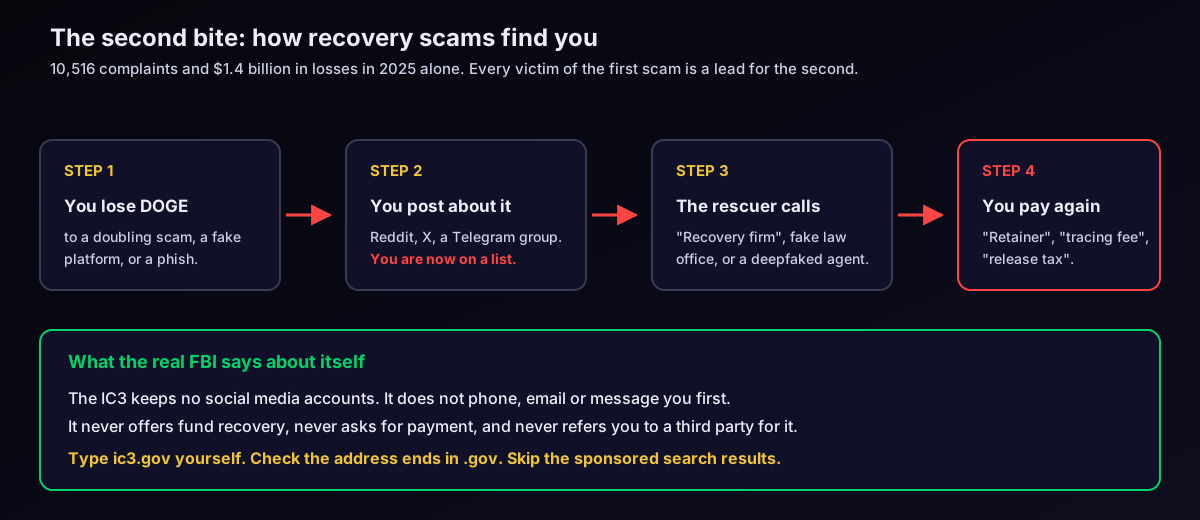
The pitch is a recovery firm, a law office specializing in crypto, or someone claiming to be an FBI agent handling your complaint. In July 2026 the FBI published a warning about exactly this: deepfaked video of a senior official directing people to fake IC3 sites that copy the real design and collect name, phone, email, scam type and loss amount.
The real IC3 keeps no social media accounts, never initiates contact by phone, email or messaging app, never offers fund recovery, and never asks for payment or refers you to a third party for it. Anyone who does all four of those things is a criminal.
The four rules that stop almost all of it
| Rule | Stops |
|---|---|
| 1. Never give anyone your recovery phrase. No exceptions, no legitimate uses. | Seed phishing, fake wallets, fake support, fake migrations |
| 2. Sending crypto to receive crypto is always a theft. Giveaways, doublings, "unlock fees," release taxes. | Doubling scams, recovery scams, fake airdrops, platform lockouts |
| 3. You contact them, never the reverse. Type the domain. Skip sponsored results and inbound calls. | Fake support, impersonation, spoofed complaint sites, agency scams |
| 4. Check the address, then test with a small amount. First four and last four characters, every time. | Clipboard hijacking, lookalike addresses, plain typos |
One more habit worth building: slow down. Every scam here manufactures urgency, because urgency is what stops people running rule 3. A real opportunity survives a twenty-minute pause. A scam does not, which is precisely why it insists you act now.
If you already sent it
Read this part carefully, because the next hour matters and the internet is about to fill up with people offering to help.
- Do not pay anybody to get it back. This is rule 2 again, and it's when you're most vulnerable to it.
- Report to IC3. Type
ic3.govinto the browser yourself. Confirm the address ends in .gov. Do not click a search ad. The FBI's Recovery Asset Team can occasionally freeze funds still sitting at a compliant exchange, but only when reported fast. - Tell the exchange immediately if the coins passed through one. Exchanges can freeze accounts. They will not un-send a transaction.
- Report to the FTC at reportfraud.ftc.gov, and to the CFTC if it involved a trading platform.
- Write down the addresses, timestamps, URLs, usernames and transaction IDs while you remember them.
- Be careful about posting publicly. A detailed public account of your loss is a qualified lead for the recovery crowd.
The honest expectation: recovery is rare. Report anyway. The aggregate data is how the FBI built Operation Level Up, which it credits with reducing potential losses by more than $500 million since 2024, and your complaint is a row in next year's version of the chart above.
The one thing worth buying
Most of the defence here is habits, not products. The exception is the recovery phrase, which is the single point of failure for everything you self-custody and which does not survive a fire, a flood, or a house move in a notebook drawer.
Sources
- 2025 IC3 Annual Report (181,565 crypto complaints, $11.366B losses, $62,604 average, losses by age, ATM/kiosk and recovery-scam figures, transaction types) · FBI Internet Crime Complaint Center, verified 2026-07-29
- FBI Warns of Scammers Impersonating the IC3 (deepfake video, spoofed complaint sites, what IC3 never does) · IC3 public service announcement, 2026-07-20, verified 2026-07-29
- Threat Actors Spoofing the FBI IC3 Website · IC3 public service announcement, verified 2026-07-29
- Customer Advisory: Six Warning Signs of Online Financial Romance Frauds · US Commodity Futures Trading Commission, verified 2026-07-29
- CFTC Digital Asset Frauds resource hub · US Commodity Futures Trading Commission, verified 2026-07-29
- FTC: $3.5 billion lost to imposter scams in 2025; ~$920M to government impersonators; ~$16B total fraud losses · Federal Trade Commission, verified 2026-07-29
- FTC: $2.1 billion lost to scams starting on social media in 2025; 60% of romance scam losses began there · Federal Trade Commission, verified 2026-07-29
- FTC consumer alert on spotting investment scams · Federal Trade Commission, verified 2026-07-29
- Scammers impersonating the Department of Government Efficiency by email (1,800 addresses, 350+ organizations) · FedScoop, verified 2026-07-29
- Scammers using the DOGE and Dogecoin name collision · NBC Boston consumer investigation, verified 2026-07-29