Who created Dogecoin? Billy Markus, Jackson Palmer, and the joke that became a coin
Two people who had never met. Billy Markus, a senior software engineer at IBM in Portland, Oregon, wrote the code. Jackson Palmer, in Adobe's marketing department in Sydney, made the joke and bought the domain. Dogecoin launched on 6 December 2013, a date you can read straight out of the software rather than take on trust. Both were gone by 2015. Neither made money. One of them now describes the entire industry he helped create as a machine for extracting cash from desperate people, and he says it in public, by name.
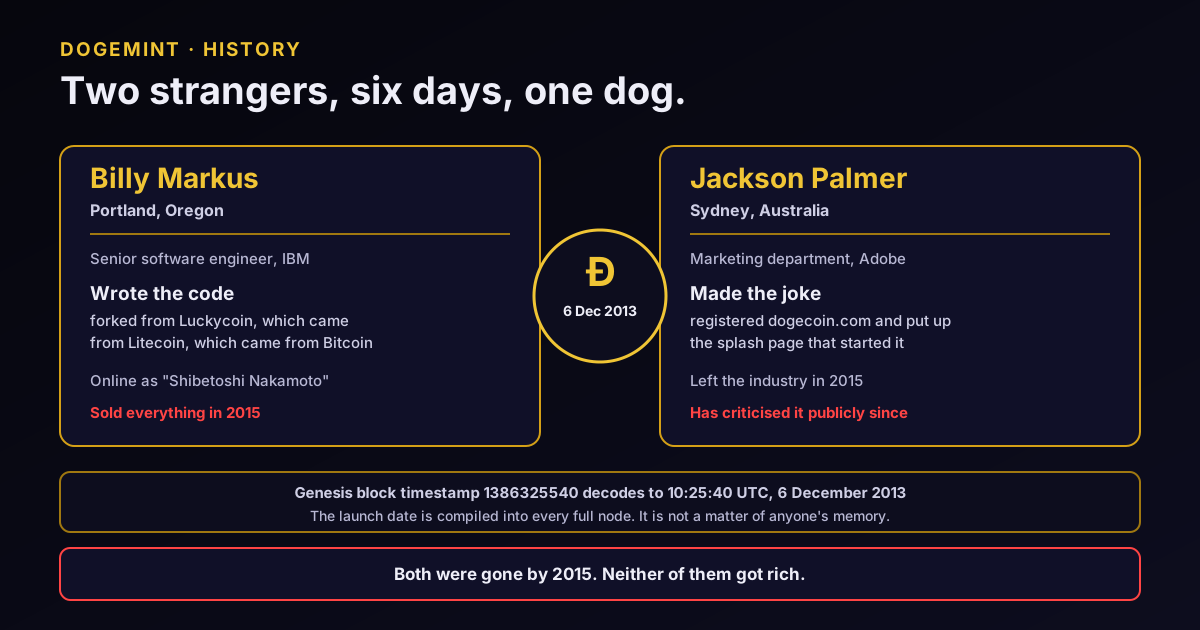
The two of them
The division of labour matters, because it is the reason Dogecoin worked and most joke coins did not. One of them could ship software. The other could make people care.
| Billy Markus | Jackson Palmer | |
|---|---|---|
| Where | Portland, Oregon | Sydney, Australia |
| Day job in 2013 | Senior software engineer, IBM | Marketing department, Adobe |
| What he did | Wrote the code, forked from Luckycoin | Made the joke, registered dogecoin.com |
| Known online as | Shibetoshi Nakamoto | Jackson Palmer |
| Left | 2015 | 2015 |
| Position today | Still posts, holds no meaningful stake | Publicly and repeatedly against the industry |
Palmer got there first, with a throwaway remark about investing in Dogecoin. Markus, who had been building his own coin and getting nowhere, saw the splash page Palmer had put up and got in touch. The build took days, not months, because almost none of it was new. That is not a criticism. It is how nearly every altcoin of that era was made, and it is why the thing shipped before the joke went stale.
The genesis block still has the receipt
Here is the part I like, because it means the founding date is not a matter of anyone's memory. It is a number, compiled into every full node on the network.
In src/chainparams.cpp, the mainnet genesis block is created with this line:
genesis = CreateGenesisBlock(1386325540, 99943, 0x1e0ffff0, 1, 88 * COIN);That first argument is a Unix timestamp. Convert it and you get 10:25:40 UTC on 6 December 2013. The last argument is the block reward: 88 DOGE, eight being a lucky number, which tells you roughly how seriously the parameters were chosen.
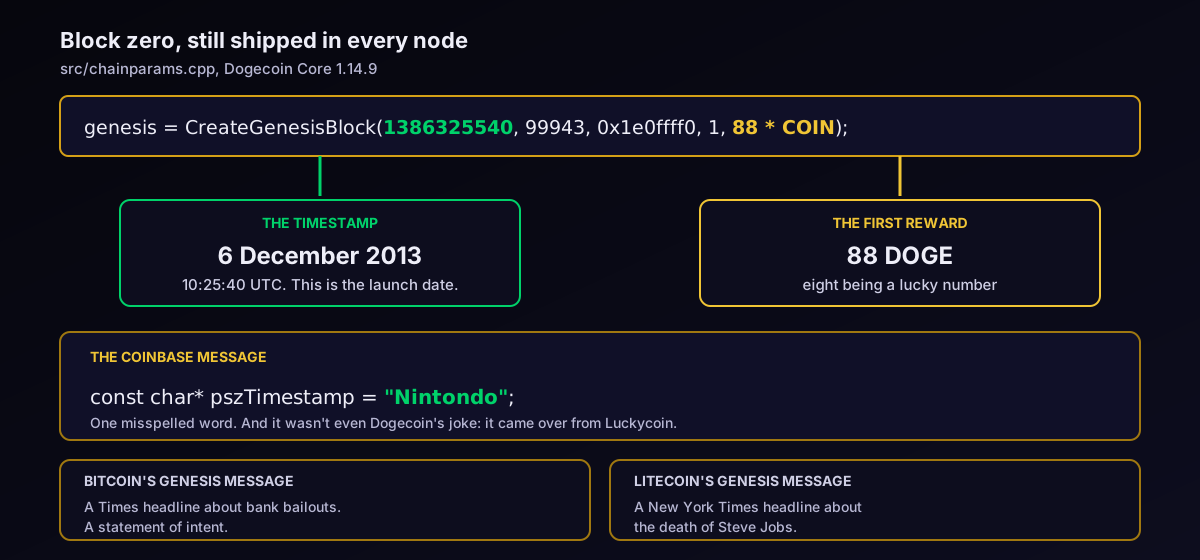
Then there is the coinbase message. Bitcoin's genesis block famously carries a Times headline about bank bailouts. Litecoin's carries a New York Times headline about Steve Jobs. Dogecoin's, set a few lines up in the same file, is this:
const char* pszTimestamp = "Nintondo";One word. A misspelled Nintendo joke. And it was not even Dogecoin's own joke, which is the detail that explains the rest of the story.
It was a fork of a fork of a fork
Markus did not build Dogecoin from Bitcoin. He built it from Luckycoin, which came from Litecoin, which came from Bitcoin. "Nintondo" was Luckycoin's genesis message, carried over unchanged.
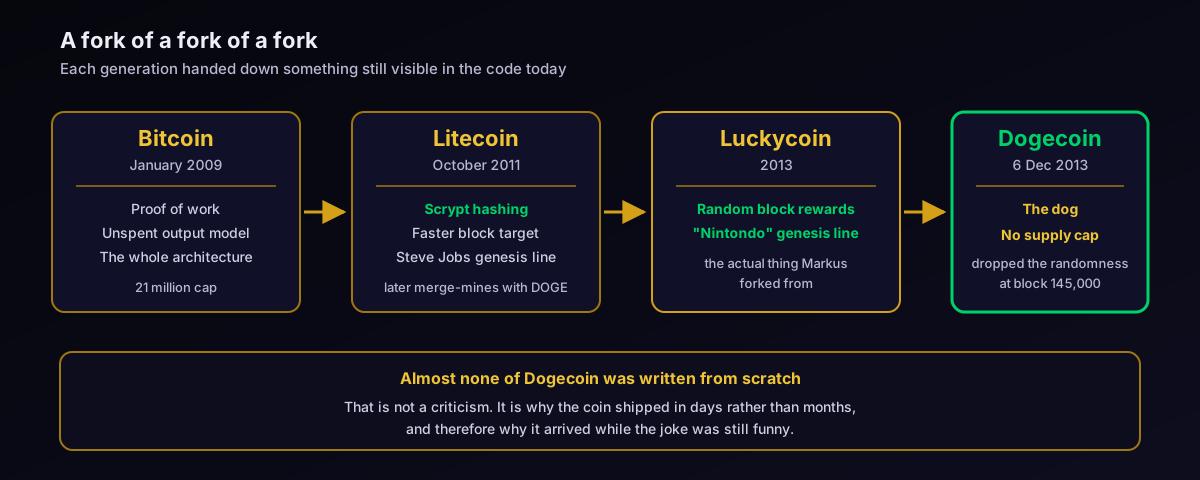
Luckycoin's distinguishing feature was a randomised block reward, and Dogecoin inherited that too. For its first 145,000 blocks, the subsidy function took a slice of the previous block's hash, seeded a random number generator with it, and paid the miner an unpredictable amount. Miners genuinely did not know what a block was worth until they found one. You can still see the branch in src/dogecoin.cpp:
return (1 + rand) * COIN;Fixed rewards arrived at block 145,000, and the flat 10,000 DOGE forever rule took over at block 600,000. So the coin people describe as "predictable inflation" spent its first months paying out by lottery. We went through all three consensus eras in Dogecoin versus Bitcoin.
The dog was real, and had nothing to do with any of this
Kabosu was a Shiba Inu, born around 2 November 2005. In 2008 she was rescued from a puppy mill by Atsuko Sato, a Japanese kindergarten teacher, who photographed her constantly and posted the pictures to a personal blog.
In early 2010 Sato posted the one. Kabosu sitting on a sofa, front paws crossed, giving the camera a look of profound suspicion. It reached Reddit and Tumblr, acquired layers of badly kerned Comic Sans, and became one of the defining internet artefacts of the decade. The word "doge" itself came from elsewhere entirely, a mid-2000s web cartoon, and got welded onto the picture later.
Note the order of events. The photograph is from early 2010. The meme was fully formed through 2013. Dogecoin arrives in December 2013, at the end. The coin is named after a joke it did not create, using a photograph of a dog whose owner had no involvement and made nothing from it.
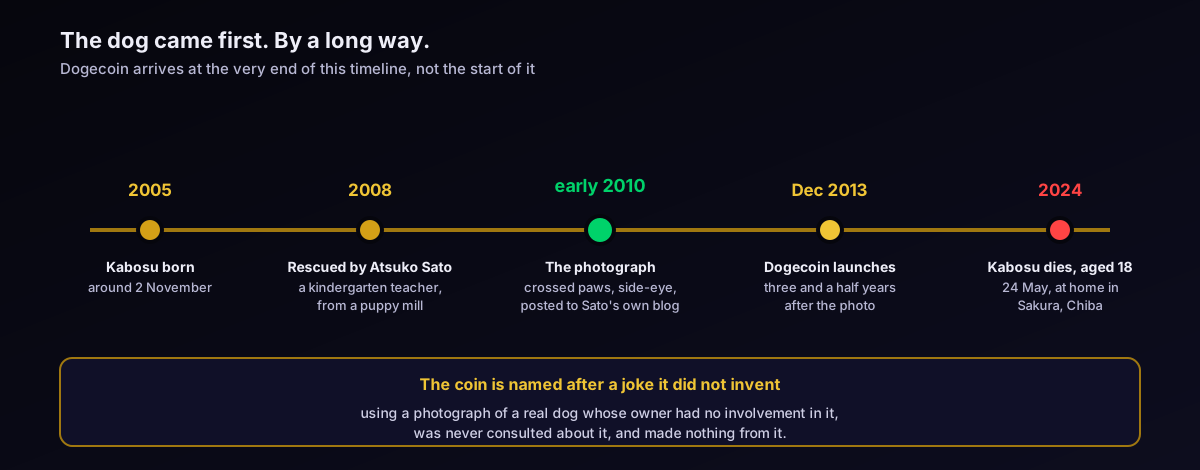
Kabosu died on 24 May 2024, aged 18, at Sato's home in Sakura, Chiba. Sato announced it on the same blog where the photograph first appeared, writing that Kabosu had gone peacefully while being petted. The coin named after her was worth around $23 billion that week.
What the community did in the first year
Markus and Palmer built the thing. What made it stick was what happened next, mostly without them, and it started badly.
On 25 December 2013, nineteen days after launch, the online wallet service Dogewallet was hacked and millions of coins were taken. The response set the tone for everything after. The community organised a drive called SaveDogemas to reimburse the victims out of their own pockets, and roughly a month later they had donated enough to cover every stolen coin. That is a genuinely unusual thing for an internet community to do, and it happened before anyone could plausibly have been protecting an investment.
Then it got sillier and more generous at the same time. On 19 January 2014 a fundraiser went up for the Jamaican bobsled team, who had qualified for the Sochi Olympics without the money to attend. On 25 March 2014 the community raised 67.8 million DOGE, about $55,000 at the time, to sponsor NASCAR driver Josh Wise. His number 98 car ran at Talladega covered in the Shiba Inu, and in May the internet voted him into the Sprint All-Star Race ahead of Danica Patrick. A separate campaign with Charity: Water raised over $30,000 from more than 4,000 donors to build a well in Kenya.
Here is the detail I like most in all of this. Somebody put the car number into the consensus rules. In src/chainparams.cpp, on the line that sets Dogecoin's auxiliary proof-of-work chain identifier:
consensus.nAuxpowChainId = 0x0062; // 98 - Josh Wise!Hex 0x0062 is 98. That comment is still there, in the current release, running on every full node on the network twelve years later. The founders were both gone within a year. The joke was load-bearing enough to end up in the protocol.
Neither founder made money, and both have said so
This is the fact that most surprises people, and both men have addressed it directly rather than through spokesmen.
Markus stepped away in 2015. He has cited harassment from parts of the community and discomfort with where it was heading. Around the same time he was laid off. In an open letter posted to the r/dogecoin subreddit in February 2021, as DOGE was climbing toward its all-time high, he wrote:
I gave away and/or sold all the crypto I had back in 2015 after being laid off and scared about my dwindling savings at the time, for about enough in total to buy a used Honda Civic.
Read that sentence carefully, because the internet has not. It describes an amount, not a purchase. There is no Honda. Markus has since said the money went on living costs. The car is entirely a product of the retelling, and it has been reported as fact hundreds of times, which is a decent lesson about how crypto history gets written.
DOGE peaked at $0.7316 on 7 May 2021, roughly six years after he sold.
What Palmer actually says
Palmer left in 2015 and stayed gone. On 14 July 2021 he broke a long silence with a thread that remains the sharpest thing any crypto founder has said about the field. His words, not a summary:
After years of studying it, I believe that cryptocurrency is an inherently right-wing, hyper-capitalistic technology built primarily to amplify the wealth of its proponents through a combination of tax avoidance, diminished regulatory oversight and artificially enforced scarcity.
And on the industry's machinery:
The cryptocurrency industry leverages a network of shady business connections, bought influencers and pay-for-play media outlets to perpetuate a cult-like "get rich quick" funnel designed to extract new money from the financially desperate and naive.
Asked whether he would return to cryptocurrency, his answer was a wholehearted no.
You do not have to agree with him. Plenty of people who hold DOGE think he is wrong about the whole category, and the "artificially enforced scarcity" line is a strange charge to level at the one coin with no cap at all. But it should be quoted accurately and it should not be waved away, because he is not an outsider taking shots. He co-founded the thing, watched it for eight years, and concluded it was harmful. That is worth more than another anonymous critic.
What he has never done is claim Dogecoin was a scam by design. The joke was a joke. The complaint is about what the industry became.
What the founding explains about the coin today
Founding stories are usually decoration. This one is load-bearing, because three permanent features of Dogecoin come directly from decisions made in a few days in 2013 by people who assumed nobody would care.
| Decision in 2013 | Why it was made | What it means in 2026 |
|---|---|---|
| Fork Luckycoin, not Bitcoin | Fastest route to a working chain | Scrypt mining, 60-second blocks, and a genesis message about Nintendo |
| No supply cap | It was a joke currency meant to be spent and tipped, not hoarded | 5.256 billion new DOGE a year, permanently. The single biggest fact about the asset. |
| Attach a meme | Palmer thought it was funny | A cultural following no competitor has replicated, and the only real moat DOGE has |
| Founders leave early | Harassment, burnout, a layoff | No founder holdings to dump, no leadership, no roadmap, no one to sue |
That last point deserves a sentence on its own. Dogecoin has no boss. There is a volunteer developer group that ships releases at its own pace, the current one being Dogecoin Core 1.14.9 from December 2024, and there is nobody who can change direction, market the coin, or promise anything. For an asset whose price moves on attention, that is a genuinely strange structure, and it is why a single person with a large following has been able to move it so far. We tracked that in the Musk timeline.
The coin outlived its own creators' involvement by more than a decade. Whether it outlives their opinion of it is a different question, and we argued that one in the reality check. If you want the version where the joke stops being funny and starts being a market, the blow-up timeline covers it, and for how DOGE stacks up against the coins that copied the formula, see the 2026 ranking or the head-to-head in DOGE versus SHIB.
Reading material
Sources
- Dogecoin Core 1.14.9, src/chainparams.cpp · mainnet genesis nTime 1386325540 (10:25:40 UTC, 6 December 2013), 88 DOGE reward, pszTimestamp "Nintondo", genesis hash 1a91e3da...5691, nPowTargetSpacing 60 · Dogecoin Project on GitHub, verified 2026-07-29
- Dogecoin Core, src/dogecoin.cpp, GetDogecoinBlockSubsidy · the randomised reward branch for the first 145,000 blocks and the constant 10,000 DOGE thereafter · Dogecoin Project on GitHub, verified 2026-07-29
- Billy Markus's February 2021 open letter to r/dogecoin, quoted in full · the verbatim "used Honda Civic" sentence, the 2015 sale and the layoff · Cointelegraph, verified 2026-07-29
- Jackson Palmer's Twitter thread of 14 July 2021, reported with verbatim quotes · the "inherently right-wing, hyper-capitalistic technology" and "shady business connections" passages, and the thread date · CBS News, verified 2026-07-29
- Dogecoin: creation and history · Markus at IBM in Portland, Palmer at Adobe in Sydney, the 6 December 2013 launch, the Luckycoin and Litecoin lineage, Palmer's 2015 departure · Wikipedia, citations followed to source where available, verified 2026-07-29
- Dogecoin 2013 to 2014 community events · the Dogewallet hack of 25 December 2013 and the SaveDogemas reimbursement drive, the Jamaican bobsled fundraiser of 19 January 2014, the 67.8 million DOGE (about $55,000) Josh Wise NASCAR sponsorship of 25 March 2014, and the Charity: Water campaign · Wikipedia, verified 2026-07-29
- Kabosu: birth around 2 November 2005, adoption by Atsuko Sato in 2008, the early-2010 blog photographs, and her death on 24 May 2024 aged 18 · Wikipedia, verified 2026-07-29
- Kabosu's death announced by Atsuko Sato on her blog, 24 May 2024 · corroborates the date, location in Sakura and Sato's account · Washington Post, verified 2026-07-29
- Dogecoin Core release history · confirms 1.14.9 of 1 December 2024 is the current release and that development is volunteer-paced · Dogecoin Project on GitHub, verified 2026-07-29
- DOGE all-time high of $0.7316 on 7 May 2021, and market capitalisation · CoinGecko, verified 2026-07-29