When did Dogecoin blow up? The complete timeline
Dogecoin launched on December 6, 2013. Three breakout moments since: January 2014 when the community crowdfunded the Jamaican bobsled team to Sochi, May 2021 when DOGE hit $0.7376 on the day of Elon Musk's Saturday Night Live appearance, and April 2023 when X (then Twitter) briefly swapped its logo for the Shiba Inu meme. Here's the full chronology, dated from contemporary reporting.
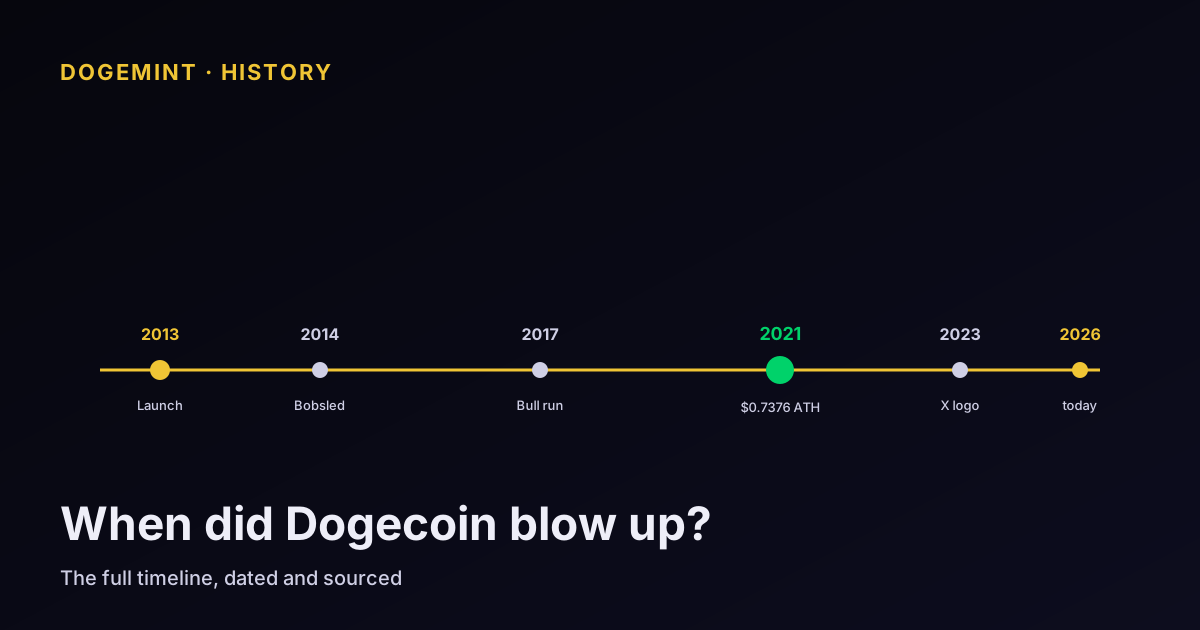
December 6, 2013 ·Launch
Billy Markus, an IBM software engineer, and Jackson Palmer, a marketing employee at Adobe, launched Dogecoin on December 6, 2013. Markus forked the code from Litecoin (which itself was forked from Bitcoin), kept the Scrypt proof-of-work, and released the network with a Shiba Inu mascot pulled from the "Doge" internet meme that had been circulating since 2010. Palmer registered the domain and the meme; Markus built the chain.
The Verge covered the launch on December 13, 2013 in "The joke's on you, Bitcoin fans: this meme currency just passed $100,000 in volume." The piece treated DOGE as half-joke, half-curiosity. Within a year, DOGE would have a market capitalization in the millions.
The original supply schedule called for 100 billion DOGE to be mined by 2015, after which 5 billion+ new DOGE would issue per year, indefinitely. Markus has since said the inflation schedule was "decided over the course of an evening" and shipped without lengthy economic analysis. The protocol has held to it ever since.
January 2014 ·The Jamaican bobsled crowdfund
The first event that put Dogecoin in front of mainstream readers. The 2014 Jamaican bobsled team had qualified for the Sochi Winter Olympics but lacked the funds for travel. The /r/dogecoin subreddit organized a crowdfund. Within days, the community raised approximately $30,000 worth of DOGE, enough to cover the team's trip.
Vice covered the story in early 2014. The narrative was perfect: a meme cryptocurrency funding underdog Olympians. The mainstream tech press picked it up, and DOGE's brand identity as the friendly, generous, slightly ridiculous crypto was cemented. Two months later, the community crowdfunded NASCAR driver Josh Wise's Sprint Cup car, leading to the iconic Doge-decaled #98 racing in Talladega.
2014–2017 ·The quiet years
Palmer publicly stepped back from active development in 2015, citing concerns about the toxicity emerging in some segments of the community. Markus had quietly exited earlier. Development continued through volunteer maintainers, with sporadic releases of Dogecoin Core that mostly tracked Bitcoin Core's security patches and Litecoin's Scrypt-related changes.
The big technical event was the 2014 addition of merged mining (auxiliary proof-of-work, AuxPoW) in Dogecoin Core 1.8.0. The change let Litecoin miners produce DOGE blocks at the same time, which solved an emerging problem: as DOGE-only mining became unprofitable, hashrate was dropping and the chain was becoming theoretically attackable. After AuxPoW, Litecoin's industrial mining hashrate effectively secured DOGE for free. The change is documented in the 1.8.0 release notes.
By 2015 the initial 100 billion DOGE were fully issued, and the protocol moved into its perpetual 10,000-DOGE-per-block phase. Price hovered between $0.0002 and $0.001 for most of 2015 and 2016. There was no halving and no scheduled supply event to pump speculation.
2017 ·First crypto bull run participation
The 2017 ICO bubble lifted essentially every cryptocurrency. DOGE went from $0.0002 in early 2017 to roughly $0.018 by January 2018, a 90x move. Most of that was a passive ride on the broader BTC/ETH bull cycle. DOGE didn't do anything particular in 2017 to deserve the move; it was simply still around when the wave came in.
The 2018 crypto winter brought DOGE back to ~$0.002 by year-end. The ratio of "DOGE going up" stories to "DOGE going down" stories on tech blogs went heavily negative.
2019–2020 ·The DOGE Army organizes
Elon Musk's first DOGE-related tweet posted on April 2, 2019 (archived via Wayback). It was a poll asking which crypto would dominate; DOGE won. Musk followed by tweeting "Dogecoin might be my fav cryptocurrency" and changed his Twitter bio to "former CEO of Dogecoin."
The Reddit-organized DOGE Army movement gained momentum through 2020, particularly during the pandemic-era retail trading wave. TikTok videos pushing "DOGE to $1" went viral in mid-2020. The price moved from $0.002 in October 2020 to $0.04 by year-end.
2021 ·The Musk-driven year
The defining year for DOGE.
- January 28, 2021: Coordinated retail buying via /r/SatoshiStreetBets and similar communities pushed DOGE from $0.008 to $0.078 in a single day. Robinhood briefly halted DOGE trading along with GME, citing volatility.
- February through April 2021: Steady appreciation. Price reaches $0.40 by mid-April.
- May 4, 2021: DOGE hits $0.69 in anticipation of Musk's SNL appearance.
- May 8, 2021 (SNL night): DOGE peaks at $0.7376, the all-time high. During the broadcast itself, where Musk played a financial expert and called DOGE "a hustle," the price fell sharply. Yahoo Finance daily high data confirms the peak.
- May 19, 2021: Crypto-wide flash crash. DOGE drops to ~$0.21. Recovers partially through summer.
- December 31, 2021: DOGE closes the year around $0.17, down 77% from the May peak but up 100x+ from January's starting point.
The 2021 cycle established DOGE as more than a meme. Coinbase listed it in June 2021 (the listing was delayed by months because of internal Coinbase debate over whether DOGE met their listing standards). Major payment processors added DOGE support. Dallas Mavericks owner Mark Cuban announced the team would accept DOGE for tickets and merchandise.
2022 ·Crypto winter
The 2022 macro environment hit every cryptocurrency. The Terra/LUNA collapse in May 2022 took down a ~$60 billion market cap stablecoin ecosystem. Three Arrows Capital, Celsius, Voyager, and FTX collapsed in sequence through the second half of the year. DOGE drew down 92% from its 2021 peak.
Through it all, the DOGE chain kept producing blocks. Hashrate dipped but recovered. /r/dogecoin's subscriber count actually grew through the bear market, suggesting community engagement wasn't purely price-driven.
April 3, 2023 ·The X logo swap
Twitter, recently rebranded under Musk's ownership, briefly replaced its bird logo with the Shiba Inu Doge meme. The swap lasted three days. DOGE jumped roughly 30% on the day of the change. The Wall Street Journal and Bloomberg both covered the move within hours.
The swap was widely interpreted as a signal that Musk's long-implied X-DOGE payment integration was imminent. As of 2026, no production rollout has shipped. DOGE still gives back most of the gains from announcements that don't materialize into shipped product.
2024–2026 ·Maturation and grind
DOGE traded in a $0.06 to $0.45 range through 2024 and into 2025, with notable spikes around macro crypto news. The 2024 Bitcoin halving lifted the broader market, and DOGE participated. The pattern from 2021 repeated in compressed form: anticipation, run-up, peak, drawdown.
Recent developments worth noting:
- SpaceX's DOGE-1 payload mission (announced 2021, paid for in DOGE) finally launched in 2024 after multiple manifest delays.
- The class action against Musk for DOGE-related market activity (Keith Johnson v. Elon Musk et al.) continued through motions and discovery in federal court.
- Major retail brokerages (Robinhood, eToro) have maintained DOGE listings without interruption.
- Merchant adoption via BitPay, NOWPayments, and Crypto.com card transactions has held steady, neither collapsing nor breaking out.
For context on where DOGE stands now relative to the "DOGE is dead" framing that resurfaces every cycle, see our 2026 reality check.
The chronology, condensed
| Date | Event | DOGE price (approx.) |
|---|---|---|
| Dec 6, 2013 | Launch (Markus, Palmer) | <$0.0001 |
| Jan 2014 | Jamaican bobsled crowdfund | $0.0002 |
| 2014 (mid) | NASCAR Doge car (Josh Wise, #98) | $0.0003 |
| 2014 | Merged mining (AuxPoW) shipped in Core 1.8 | $0.0003 |
| Jan 2018 | End of first crypto bubble | $0.018 |
| Apr 2, 2019 | Musk's first DOGE tweet | $0.003 |
| Jan 28, 2021 | Reddit-driven rally, Robinhood halt | $0.078 |
| May 8, 2021 | Musk SNL appearance ·ATH | $0.7376 |
| Jun 2021 | Coinbase lists DOGE | $0.30 |
| Dec 2022 | FTX collapse, crypto winter trough | $0.07 |
| Apr 3, 2023 | Twitter logo swap to Doge | $0.10 |
| 2024 | SpaceX DOGE-1 launch (delayed since 2021) | $0.18 |
| 2026 | Range: $0.10 to $0.45 in past 12 months | varies |
Why the timeline matters
If you're trying to forecast where DOGE goes next, the historical pattern is the closest thing to data we have. Three observations from the timeline:
DOGE moves on attention, not fundamentals. Every major price event maps to a media or cultural moment, not a protocol change or adoption milestone. The bobsled crowdfund, the Reddit rally, SNL, the X logo swap. None of those changed what the protocol does; all of them changed who was paying attention.
The chain is durable. 13 years of continuous operation through three major bear markets and at least one existential security narrative (the 2014 hashrate scare that AuxPoW solved). Most 2013-era altcoins are dead. DOGE persists.
Crashes are 80%+, recoveries are slow. Holders who bought at the 2021 peak waited several years to break even, and many haven't. If you can't sit through that, you can't hold DOGE.
Reading material
Books with chapters relevant to DOGE's history:
Frequently asked
What was Dogecoin's price at launch?
Effectively zero. DOGE traded under a fraction of a cent for most of the first year. The first Coinbase-listed price for DOGE in 2021 was already several thousand percent above the launch range.
Who currently maintains Dogecoin Core?
The Dogecoin Project, a volunteer maintainer group, with funding and direction support from the Dogecoin Foundation (re-established in 2021). Source code lives on GitHub.
Did Dogecoin ever halve?
No. DOGE has issued exactly 10,000 DOGE per block since the original 100 billion were mined in 2015. There is no halving schedule.
What was the Doge meme image?
Kabosu, a Shiba Inu owned by Atsuko Sato in Sakura, Japan. The original photograph that became the meme was posted to Sato's blog in February 2010. Kabosu passed away in May 2024.
How did DOGE survive when most 2013-era coins didn't?
Three reasons usually cited: a recognizable mascot, an active community organized around the original Reddit subreddit, and merged mining with Litecoin (which secured the chain economically once GPU mining became unprofitable).
Sources
- "The joke's on you, Bitcoin fans" ·The Verge, December 13, 2013
- Dogecoin Core 1.8.0 release notes (AuxPoW) ·Dogecoin Project, accessed 2026-05-03
- DOGE-USD historical price (2014–present) ·Yahoo Finance, accessed 2026-05-03
- Wayback Machine archives of Musk's Twitter timeline ·Internet Archive, accessed 2026-05-03
- Dogecoin Foundation official site ·accessed 2026-05-03
- Dogecoin Core source repository ·Dogecoin Project on GitHub, accessed 2026-05-03